Argon

Ar    CAS Number 7440-37-1     UN1006  (gas)     

Argon

Ar|CAS Number 7440-37-1|UN1006 (gas)|

Gas volume

Calculating the volume or mass of a given amount of gas

At the boiling point (1atm | 87.3k) Equal to: -185.85 C° || -302.53 F°

Gas phase

(at STP conditions)

The phase diagram of a molecule shows the transition between solid, liquid, and gas phases as a function of temperature and pressure.

Solid phase    Liquid phase    Vapor phase    Critical point    Triple point
Molar mass: 17.030 g/mol
Percentage of presence in dry air/
Critical point Temperature: 132.50 °C Pressure:
112.8 bar
Density:
235.00 kg/m³
Triple point Temperature: -77.66 °C
Pressure:
6.1111E-2 bar

Pressure equal to 1.013 bar

9.9937E-1 Z compressibility coefficient
1.6696 Cp/Cv γ Ratio
kg/m³ 1.6335 Gas density
vol/vol 854.24 Gas equivalent/(liquid at boiling point)
kJ/(kg·K) 5.2155E-1 Heat capacity Cp
kJ/(kg·K) 3.1238E-1 Heat capacity Cv
mol/mol 2.519E-5 Solubility in water
1.38 Special price
m³/kg 6.122E-1 Special volume
mW/(m·K) 17.746 Thermal conductivity
Po 2.2624E-4 Viscosity
9.9925E-1 Z compressibility coefficient
1.6698 Cp/Cv γ Ratio
1.6903 kg/m³ چگالی گاز
825.53 vol/vol Gas/liquid equivalent (at boiling point)
5.2165E-1 kJ/(kg·K) Heat capacity Cp
3.1241E-1 kJ/(kg·K) Heat capacity Cv
3.025E-5 mol/mol Solubility in water
1.38 Special price
5.916E-1 m³/kg Special volume
17.245 mW/(m·K) Thermal conductivity
2.1987E-4 Po Viscosity
9.9906E-1 Z compressibility coefficient
1.6702 Ratio Cp/Cv
5.772 kg/m³ Gas density (at boiling point)
1.7835 kg/m³ Gas density
782 vol/vol Gas/liquid equivalent (at boiling point)
5.2185E kJ/(kg·K) Heat capacity Cp
3.1243E-1 kJ/(kg·K) Heat capacity Cv
1.38 Special price
5.607E-1 m³/kg Special volume
16.483 mW/(m·K) Thermal conductivity
2.1017E-4 Po Viscosity

GHS04

Gas under pressure

Safety Principles for Using Argon Gas (as a Gas)

1. Asphyxiation Hazard (Most Significant Risk):

Argon is a gas naturally present in the atmosphere, but its concentration in the breathable air is very low (about 0.93%). It is heavier than air and, in the event of a leak in confined spaces with inadequate ventilation, it can displace oxygen, leading to a reduction in its concentration in the environment.

Symptoms of Oxygen Deficiency:

  • Headache, dizziness, nausea
  • Increased heart rate, confusion
  • Loss of consciousness and even death in severe cases

Preventive Measures:

  • Adequate Ventilation: Always use argon in environments with sufficient ventilation.
  • Oxygen Monitoring: In areas where argon leakage is possible, use oxygen sensors.
  • Training: Workers should be trained on the risks of asphyxiation and safe handling procedures.
  • Cylinders: Always transport cylinders away from work areas, using appropriate hoses and regulators.

2. High Pressure:

Argon is stored in cylinders at very high pressure (usually between 150 to 200 bar), which in itself presents hazards.

Risks:

  • Cylinder projection if not properly secured
  • Rupture due to impact or high temperature
  • Damage to valves and the risk of dangerous leaks

Preventive Measures:

  • Always secure cylinders with chains or straps.
  • Use appropriate regulators to reduce pressure.
  • Transport cylinders with protective caps and keep them in an upright position.
  • Keep cylinders away from heat sources and sparks.

3. Frostbite (Less Likely in Gas Form, but Notable):

Although frostbite risk is less in gas form, a severe leak from a regulator or hose may temporarily form liquid argon. Argon boils at very low temperatures (-186°C), and contact with it can cause frostbite.

Preventive Measures:

  • In case of a leak, immediately leave the area and address the leak.
  • Use protective gloves and face shields in case of potential contact.
Welding and Metal Cutting (Shielding Gas):
One of the most common and important applications of argon is its use as a shielding gas in welding processes:
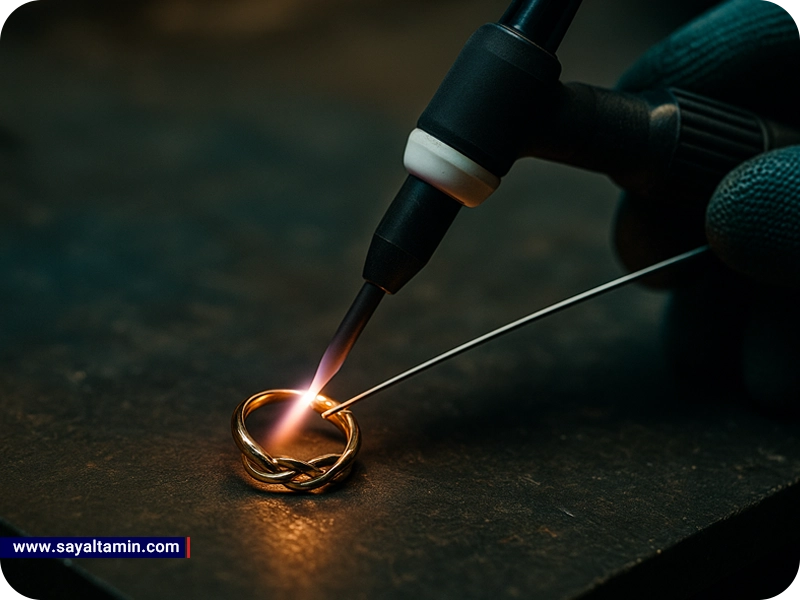
  • TIG Welding (Tungsten Inert Gas): In this method, argon surrounds the weld area and the tungsten electrode, preventing it from contacting air and protecting it from oxygen and nitrogen. This protective layer results in clean, uniform welds without oxidation.
  • MIG Welding (Metal Inert Gas): In this method, argon is used alone or in combination with gases like CO₂ or O₂ as a shielding gas to protect the weld pool from atmospheric contamination.
  • Plasma Cutting: In some plasma cutting systems, argon is used as the primary gas to form the plasma arc, increasing the accuracy and quality of the cut.
Argon Welding
Argon in Lamps and Lighting:
  • Incandescent Lamps: Argon, combined with nitrogen, is used in incandescent lamps to reduce tungsten filament evaporation, extending the lamp's lifespan.
  • Fluorescent Lamps: Argon acts as a carrier gas for mercury vapor, generating ultraviolet light that, when interacting with the phosphor coating, is converted into visible light.
  • Gas Discharge Lamps: In neon, xenon, and similar lamps, argon is used as a filling or starter gas for electrical discharge.
Argon Lamps
Argon in Electronics and Semiconductors:
  • Silicon and Germanium Crystal Growth: In semiconductor production, argon is used as a neutral gas to prevent unwanted reactions with sensitive materials.
  • Sputtering Coating: Ionized argon is used to remove metal or insulating atoms from a target surface and deposit them onto a substrate, a common method in electronics manufacturing.
Argon Electronics
Argon in the Food and Beverage Industry:
  • Food Packaging: Argon replaces oxygen in food packaging to prevent oxidation, spoilage, and discoloration of foods such as meat, fish, and cheese.
  • Preservation of Beverage Quality: In beverage production, argon creates a protective layer over the liquid surface, preventing contact with oxygen and thus preventing oxidation.
Argon Food Packaging
Argon in Scientific Analysis and Measurement:
  • Plasma Spectrometry (ICP-AES and ICP-MS): Argon is used as the plasma gas to ionize samples in precise elemental analysis.
  • Gas Chromatography (GC): In certain methods, argon is used as a carrier gas to transfer samples in a chromatography column.
Argon Laboratory
Argon in Steel and Casting Industries:
  • Molten Metal Refining: Injecting argon into molten metals removes gas bubbles and impurities, improving the mechanical properties of the metal.
  • Protective Atmosphere in Molding: In precision casting, argon prevents oxidation and contamination of metals as they cool inside molds.
Argon Casting