


This post is also available in: Persian Armenian
In recent decades, advanced optical technologies in areas such as high-power lasers, space imaging, semiconductor lithography, and optoelectronic systems have faced significant challenges in controlling wavefront distortions. Adaptive optics, as a solution for real-time correction of wavefront errors, has primarily been developed based on deformable mirrors and spatial light modulators. However, the emergence of the concept of “adaptive optics based on tunable gases” has opened a new horizon in optical field engineering.
In this approach, instead of physically deforming solid surfaces, the refractive index of gases is controlled through adjustments in pressure, temperature, chemical composition, or electric fields. These changes can be applied continuously and at very high speed, enabling precise control over phase, focus, divergence, and even intensity profiles of light beams.
Gases such as Argon, Nitrogen, Carbon Dioxide, and engineered mixtures thereof are attractive options for creating dynamic optical environments due to their chemical stability, broad spectral transparency, and precise tunability of thermodynamic parameters.
Light, in its simplest definition, is a form of electromagnetic energy whose behavior changes when passing through different media depending on the physical properties of those media. One of the most important of these properties is the refractive index, a parameter that determines the speed of light in a material and how it changes direction.
In solids and liquids, the refractive index is generally constant or varies within a narrow range. In gases, however, due to their low density and high sensitivity to pressure and temperature, the refractive index can be modified in a controllable manner. This characteristic forms the basis of a new generation of optical systems where the gaseous medium is not merely a passive light-transmitting medium but an active element in optical field engineering.
Adaptive optics were first developed to compensate for atmospheric turbulence in astronomical telescopes. In large observatories, such as the European Southern Observatory, random variations in the refractive index of air in different atmospheric layers cause severe distortion of starlight images. To correct this, deformable mirrors were implemented, capable of changing shape thousands of times per second.
But can the light-propagating medium itself be engineered instead of reshaping the mirror?
The idea of using tunable gases stems directly from this question. By controlling the pressure or composition of the gas to create refractive index gradients, the wavefront can be continuously corrected. This approach not only eliminates complex mechanical components but also provides faster response times, reduced weight, and better thermal stability.
In advanced industries, particularly high-power laser systems, even very small temperature variations can cause thermal distortions. Using inert gases such as Argon as a tunable medium allows simultaneous optical correction while also aiding in cooling. This synergy between gas engineering and optical engineering creates a novel platform for the development of next-generation optical technologies.
From an industrial perspective, this technology presents a strategic opportunity for suppliers of gas condensates and process gases, since the quality, purity, moisture control, and stability of the gas mixture directly affect optical system performance. In such cases, the gas is no longer just a consumable; it becomes an integral part of the optical system infrastructure.
Physical Principles of Refractive Index Modulation in Gases and Related Mathematical Models

To understand how gases can be used as tunable optical elements, we first need to answer a fundamental question: why does the refractive index of a gas change?
What is the Refractive Index and Why Is It Controllable in Gases?
The refractive index (n) is the ratio of the speed of light in a vacuum to its speed in a given medium. In a vacuum, this value is exactly 1, but in materials it becomes slightly greater than 1. In gases, the refractive index is usually very close to 1 (for example, around 1.0003 for air under standard conditions), yet even this small difference can produce significant effects in long optical paths or precision systems.
The physical origin of the refractive index lies in molecular polarizability. When a light wave passes through a gas, its electric field slightly displaces the electrons of the atoms or molecules. This displacement generates secondary fields that collectively alter the propagation speed of the wave.
Gases like Nitrogen or Argon have simple atomic or molecular structures, resulting in stable and predictable optical behavior. In contrast, gases with more complex structures, such as Carbon Dioxide, may exhibit different spectral dependencies.
Refractive Index and Gas Density
Under typical industrial pressures, the refractive index of a gas is approximately proportional to its density. This relationship can be described by the Lorentz–Lorenz equation, which states that:
The refractive index is a function of molecular polarizability and the number of molecules per unit volume.
Since gas density increases with pressure and decreases with temperature, we get:
- Increasing pressure → increased density → increased refractive index
- Increasing temperature → decreased density → decreased refractive index
This simple relationship forms the foundation of gaseous adaptive optics. By controlling the pressure at different points within a gas chamber, one can create refractive index gradients—similar to a GRIN (gradient-index) lens, but without any solid elements.
Refractive Index Gradient and Wavefront Shaping
When the refractive index in a gaseous medium varies spatially, the path of light beams curves. This phenomenon can be described using a generalized form of Snell’s law.
- A radial gradient can make the gas act like a lens.
- A linear gradient can deflect the beam.
- More complex gradients can correct intricate wavefront distortions.
In advanced astronomical systems, such as those developed at NASA, turbulence-induced distortions are a major challenge. Interestingly, the same random density variations in the Earth’s atmosphere that cause image distortion can, if engineered properly, become tools for optical correction.
Gas Response Time to External Stimuli
One key advantage of gaseous media over mechanical elements is their rapid response to changes in pressure or temperature. Using:
- Electrothermal actuators
- Fast pressure pumps
- Electric fields in ionizable gases
…it is possible to induce optical changes on the millisecond or even microsecond scale.
In special cases, if the gas approaches a plasma state, refractive index variations can become much more pronounced. This area intersects with controlled plasma technologies, which have been explored in certain advanced research projects.
Spectral Dependence of Refractive Index
Another important factor is dispersion. The refractive index of gases depends on the light wavelength. For example, in the ultraviolet or infrared regions, the optical behavior of a gas can differ from that in the visible spectrum.
This feature is critical for laser applications. For instance, in CO₂ laser systems, which rely on Carbon Dioxide gas, precise control of the gas composition affects both laser output and optical behavior of the medium.
Comparative Optical Properties of Common Gases
| Gas | Approx. Refractive Index at 1 atm | Pressure Sensitivity | Spectral Transparency | Chemical Stability |
|---|---|---|---|---|
| Argon | ~1.000281 | High | Broad (UV to IR) | Very High |
| Nitrogen | ~1.000298 | High | Visible & Near IR | High |
| Carbon Dioxide | ~1.00045 | Medium | Strong IR | Medium |
| Helium | ~1.000036 | Low | Very Broad | Very High |
Why This Matters for the Gas Industry
In advanced gas-based optics, gas purity, precise moisture control, and pressure stability are crucial. Impurities at the ppm level can introduce spectral absorption or alter dispersion behavior.
Consequently, suppliers of gas condensates and industrial gases that provide high-purity, stable gases are effectively integrated into the value chain of advanced optical technologies.
Classical Adaptive Optics vs. Gas-Based Adaptive Optics
In classical adaptive optics, mechanical components like deformable mirrors are used to correct wavefront errors. In gas-based adaptive optics, the refractive index of the gas itself is engineered, offering a lighter, faster, and potentially more thermally stable alternative.
This approach opens new avenues in high-precision optical systems, including astronomical telescopes, high-power lasers, and dynamic imaging systems.
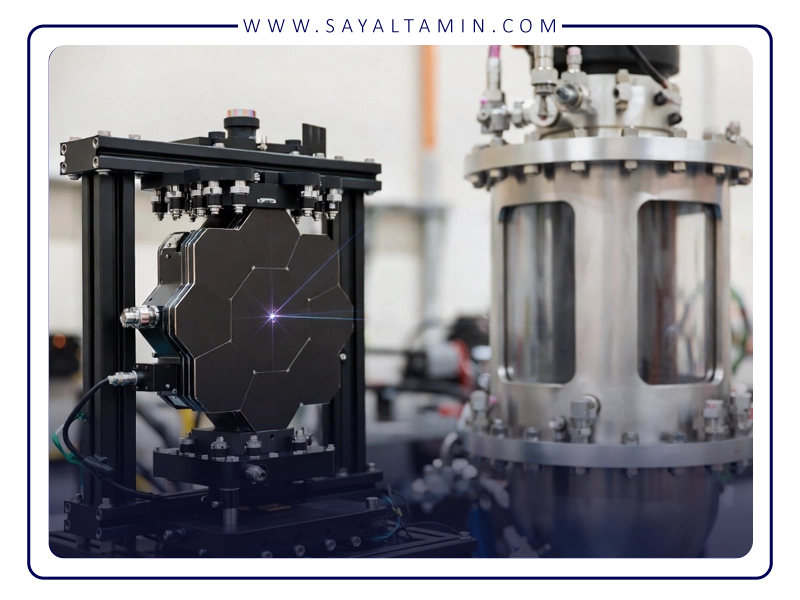
1. How Classical Adaptive Optics Works
Classical adaptive optics was originally developed to compensate for atmospheric turbulence in astronomical telescopes. These systems have three main components:
- Wavefront Sensor
- High-speed Signal Processor
- Deformable Mirror
At observatories such as the European Southern Observatory and NASA-affiliated projects, mirrors with hundreds to thousands of actuators are used, reshaping thousands of times per second to correct distortions caused by the Earth’s atmosphere.
While highly precise, this technology has significant limitations: mechanical complexity, high cost, sensitivity to vibration, and the need for meticulous maintenance. In high-power laser industries, adaptive mirrors are also used to correct thermal distortions, but at high powers, thermal stress and optical coating degradation become major challenges.
2. Inherent Limitations of Solid Adaptive Elements
Every solid optical element faces fundamental constraints:
- Mass and mechanical inertia
- Material fatigue under continuous deformation
- Sensitivity to thermal shock
- Limited deformation range
Even the most advanced MEMS mirrors are restricted by their physical limits. Additionally, any reflective or transmissive surface carries the risk of absorption and localized heating, which can be destructive in high-power laser applications. This motivates the idea of replacing solid surfaces with a programmable medium.
3. Gas-Based Adaptive Optics: Modifying the Medium Instead of the Mirror
In gas-based adaptive optics, instead of reshaping a surface, the refractive index distribution within a gas volume is controlled. This can be achieved by:
- Localized pressure adjustments
- Controlled temperature gradients
- Altering gas composition
- Electrical stimulation in specific gases
For example, in a high-purity Argon chamber, a radially increasing pressure creates a refractive index gradient that acts like a converging lens—without any moving mechanical parts.
This approach offers several key advantages:
- Eliminates costly mechanical components
- Increases laser power tolerance
- Reduces thermal stress
- Enables design of larger optical volumes
4. Functional Comparison of the Two Technologies
| Criterion | Classical Adaptive Optics | Gas-Based Adaptive Optics |
|---|---|---|
| Active Element | Deformable Mirror | Gas medium with refractive index gradient |
| Mechanical Parts | Many | Minimal |
| Laser Power Tolerance | Limited by surface coating | Very high (with proper gas selection) |
| Response Time | Milliseconds | Milliseconds to microseconds |
| Maintenance Cost | High | Medium to low |
| Vibration Sensitivity | High | Low |
| Medium Purity Requirement | Low | Very High |
Important Note: In gas-based systems, the gas quality directly affects optical performance. Presence of water vapor, unwanted oxygen, or hydrocarbon impurities can cause local absorption, wavefront distortion, or heating.
5. Industrial and Economic Analysis
From an industrial perspective, gas-based adaptive optics represents a paradigm shift. Here, the gas evolves from a simple consumable to a critical functional element.
In advanced semiconductor lithography systems, developed by companies like ASML, precise control of the optical environment at the nanometer scale is essential. While current systems rely on vacuum and highly controlled environments, similar principles of precise optical medium management apply.
If gas-based adaptive optics becomes industrially widespread, gas suppliers will need to provide:
- Ultra-High Purity filtration systems
- Precise moisture control (ppb level)
- Pressure stability with fluctuations below 0.01%
- Capability to accurately mix gas blends
In other words, this new optical technology could push the industrial gas market toward significantly higher standards.
Applications of Gas-Based Optics in Advanced Light Fields
Gas-based adaptive optics can be applied in:
- High-power laser systems for industrial and scientific use
- Astronomical telescopes to correct atmospheric turbulence
- Advanced imaging and microscopy
- Semiconductor lithography with extreme precision
- Dynamic optical systems where rapid refractive index modulation is needed
This technology integrates gas engineering with optical engineering, turning gases into active components of optical systems rather than passive media.

1. High-Power Industrial and Research Lasers
In high-power lasers, one of the biggest challenges is thermal distortion. When a laser beam passes through a medium or reflects off a mirror, even minimal absorption can raise the temperature. This temperature increase alters the refractive index of the material, producing a phenomenon known as thermal lensing.
In advanced high-power systems developed at research centers such as Lawrence Livermore National Laboratory, controlling thermal distortion is critical. Here, gas-based optics can play a dual role:
- As a cooling medium
- As a wavefront-correcting element
For example, using high-purity Argon in a controlled chamber can provide effective heat transfer while simultaneously performing optical correction through pressure adjustments. This combination of thermal and optical management is difficult to achieve with traditional solid elements.
2. Astronomical and Space Imaging
As mentioned earlier, atmospheric distortion is a major challenge in astronomy. On Earth-based telescopes, random variations in air density deflect starlight.
In projects linked to the European Southern Observatory, adaptive mirrors are used to correct these distortions. However, the concept of using controlled gas cells as a pre-compensator is under investigation.
In this approach, before the light reaches the main mirror, it passes through a gas chamber with a controlled refractive index gradient, partially correcting the wavefront. This reduces the corrective load on the mirror and improves final imaging accuracy.
Physically, this is fascinating: the same phenomenon that causes disturbances in the atmosphere, when scaled down and controlled, becomes a corrective tool.
3. Semiconductor Lithography and Chip Manufacturing
In the semiconductor industry, precise control of optical fields at the nanometer scale is critical. Companies like ASML have developed lithography systems with extreme precision, where even tiny refractive index variations in the medium can introduce pattern errors.
While many of these systems operate in vacuum or highly controlled environments, using gas media with precise specifications can aid ultra-fine optical adjustments.
For example, engineered mixtures of Nitrogen and Helium can create a medium with controlled dispersion optimized for specific wavelengths. At this level of precision, even variations of a few ppm in the gas composition can make a difference. Therefore, gas quality becomes an optical parameter, not merely a technical specification.
4. Defense and Laser Guidance Systems
In defense applications and laser-guided systems, rapid wavefront correction is essential for precise beam focusing. Adjustable gas media can provide instant correction without moving mechanical components.
Particularly at high powers, removing solid optical surfaces reduces the risk of damage. Using inert gases like Argon or Nitrogen also provides advantages in safety and stability.
5. Advanced Optical Telecommunications
In Free Space Optical Communication (FSO) systems, laser beams must pass through atmospheric layers. Turbulence can weaken and distort the signal.
One innovative idea is to employ gas-based pre-compensation modules at the transmitter to counteract expected atmospheric distortions in advance. This technology can increase optical link capacity and improve communication stability.
Importance of Gas Purity in These Applications
A common factor across all these domains is gas quality. Impurities such as moisture, heavy hydrocarbons, or excess oxygen can:
- Cause localized absorption
- Induce unwanted heating
- Create inhomogeneous dispersion
- Alter the effective refractive index
As a result, gas supply standards for optical applications are far stricter than for typical industrial uses.
Engineering Design of Gas-Based Adaptive Optics Systems
The design of these systems requires precise control over:
- Gas composition and purity
- Pressure gradients
- Temperature regulation
- Rapid modulation mechanisms (electro-thermal, pressure pumps, or electric fields in ionizable gases)
By combining these parameters, gas-based adaptive optics systems can achieve high-speed, high-precision, and thermally stable wavefront control—opening new possibilities in lasers, space imaging, lithography, defense, and optical communications.


5. Industrial Outlook
From an industrial perspective, gas-based optics presents a strategic opportunity for gas suppliers. Gas is no longer a simple commodity; it has become an optical infrastructure. Companies capable of providing:
- Ultra-high-purity gases
- Tunable gas mixtures
- Precise moisture and pressure control
…can directly enter the value chain of laser, aerospace, and semiconductor technologies. This translates into enhanced brand importance, higher added value, and stronger competitive positioning in the global market.
Gas-based adaptive optics represents a remarkable convergence of optical engineering, fluid dynamics, and materials engineering. Unlike traditional systems that rely on deformable mirrors or solid optical elements, this approach uses controlled variations in the refractive index of gases to correct wavefront distortions.
Advantages of this technology include:
- Rapid response to environmental changes and wavefront errors
- Reduced mechanical components, leading to lower maintenance costs
- High optical power tolerance, particularly in high-power laser systems
- Capability to create complex refractive index gradients for correcting diverse optical distortions
However, there are limitations and challenges. The range of refractive index variation in gases is inherently limited, and generating precise spatial gradients requires advanced engineering design, robust chambers, and precise pressure and temperature control. Additionally, gas quality and purity directly affect optical performance, and any impurity can lead to unwanted absorption or scattering.
From an industrial standpoint, this technology opens new opportunities for suppliers of liquefied and industrial gases. Gas is no longer just a consumable; it is an integral part of the optical infrastructure of advanced systems. Providing ultra-high-purity gases, precise mixture and moisture control, and stable pressure can become a key competitive advantage in optical, aerospace, and semiconductor markets.
Ultimately, gas-based optics is not only an emerging technology but also a strategic pathway for developing advanced optical systems. With progress in modeling, control, and gas purity, it can secure a prominent position in sensitive and forward-looking industries.
————————————————–
resource
- Monitoring changes in the refractive index of gases by means of a fiber optic Fabry‑Perot interferometer sensorUltrasensitive Gas
- Refractometer Using Capillary‑Based Mach–Zehnder InterferometerRefractive index sensing of gases based on a one‑dimensional photonic
- crystal nanocavityGas refractive index sensor with an integrated prism and a microlens arrayHigh‑Precision Interferometric Measurements of
- Gas Refractive Index Using Homodyne Detection (2025)Characterization and Sensing of Inert Gases with a High‑Resolution SPR Sensor