


This post is also available in: Persian Armenian
Hail is a natural phenomenon that can cause severe damage to the body of a car. Even small hailstones can cause irregular, visible dents in the roof, hood, and other metal parts of a car. In many cold regions or areas with sudden changes in weather, hail damage is one of the most common reasons for cars to be sent to repair shops.
In the past, traditional methods such as hammering or buffing and repainting the body were widely used. However, these methods were time-consuming, expensive and required repainting, which consequently reduced the value of the car. In recent decades, with the development of new technologies in the field of car body repair, new paintless dent repair (PDR) methods have been introduced. One of the prominent and modern methods in this field is the use of carbon dioxide (CO₂) gas to remove dents caused by hail.
This technology, which was originally used in the aerospace and precision equipment industries, has now become a popular method in specialized auto body repair shops.
Scientific principles of the method using carbon dioxide
Carbon dioxide, in liquid or solid form (dry ice), can create very low temperatures. When this gas is applied to the metal surface of the car body, the rapid temperature change causes the metal to contract suddenly. This contraction, in contrast to the previous heat (usually created with an industrial hair dryer or heat source), causes the metal to return to its original state and the dent disappears.
This method actually uses the physical principle of expansion and contraction of metals:
When metal is heated, it expands, and when it cools, it contracts. If these temperature changes are carried out in a controlled manner, the shape of the metal surface can be restored to its original state.
Steps for performing restoration using carbon dioxide
1. Damage assessment
First, the technician will assess the extent and depth of the hail damage. This will determine whether the CO₂ method is appropriate or if a combination method (such as PDR with heat) is needed.
2. Local heating
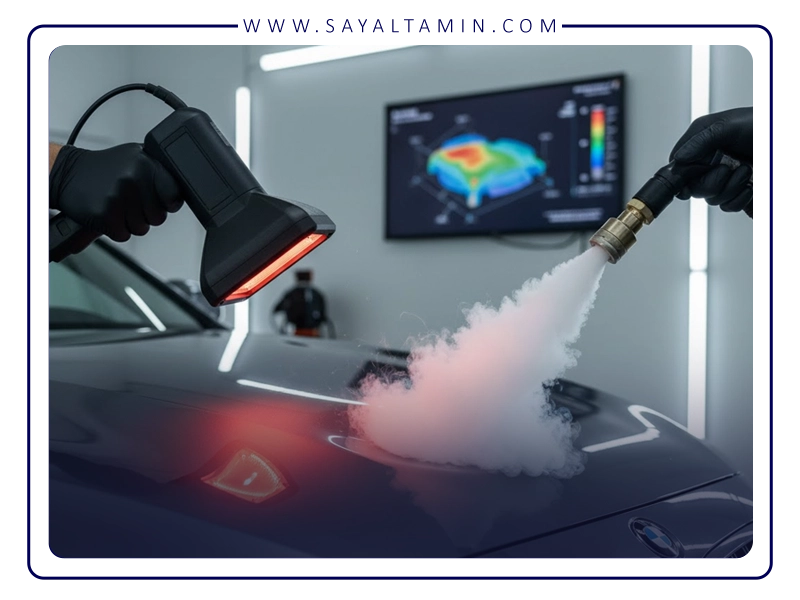
The indentation site is heated to about 60 to 80 degrees Celsius using a heat source (usually a heat gun or infrared lamp). This heat softens the molecular structure of the metal, allowing it to deform.
3. Applying carbon dioxide
Next, CO₂ gas or dry ice is rapidly sprayed onto the same area. The sudden cold (around -78°C) causes the metal in the dent to contract rapidly, and this sudden change in pressure causes the metal surface to spring back outwards, correcting the dent.
4. Final inspection and surface finishing
After the dent is removed, the body surface is inspected with optical instruments to correct any possible irregularities. If necessary, a final polishing operation is performed to restore the surface shine.
Advantages of using the CO₂ method in hail damage repair
1. No need to repaint
Unlike traditional polishing methods, this technique preserves the original paint finish of the vehicle because no physical impact or sanding is involved. This feature not only helps preserve the beauty of the vehicle, but also does not reduce its value.
2. High speed and lower cost
The CO₂ restoration process typically takes between 15 and 60 minutes, while traditional methods can take several hours to several days. Additionally, the lack of the need for paint or fillers significantly reduces costs.
3. Safety and environmental compatibility
The carbon dioxide used in this method is usually made from recycled industrial gases, so its environmental impact is much lower than methods that use dyes and chemical solvents.
4. High precision and complete control over the process
Because the temperature change is applied in a localized and controlled manner, the risk of paint damage or surface cracking is very low. The technician can precisely adjust the temperature, contact time, and intensity of the CO₂ spray.
5. Application for all types of body metals
This method is effective for steel, aluminum, and even some light alloys used in modern cars.
Difference between CO₂ method and other dye-free methods (PDR)
1. Conventional methods of paintless dent repair (known as PDR or Paintless Dent Repair) typically use mechanical tools such as long levers, hooks, or special adhesives. These tools allow the repairer to restore dents caused by hail or impact to their original state by applying pressure from behind the panel or pulling from the outside.
2. Although this method is effective, it requires a high level of skill and, if too much pressure is applied, it may cause paint cracking or unwanted deformation of the metal. It can also be very difficult to repair in areas where access to the back of the body is limited (such as pillars or roof edges).
3. In contrast, the thermal method using carbon dioxide (CO₂) gas is a relatively new and advanced technology. Instead of mechanical tools, this method uses a combination of heat and sudden cold to restore the shape of the metal. First, the damaged area is heated to a certain temperature by a heat source (such as an industrial hair dryer or infrared lamp) and then CO₂ gas is immediately sprayed onto the surface at high pressure. This rapid temperature change (from about 60 to 70 degrees Celsius to a few degrees below zero) causes the metal molecules in the dent to contract strongly and naturally return to their original shape.
4. The main advantage of this method is that it reduces the risk of damage to the body paint, as there is no direct contact or mechanical pressure on the surface. On the other hand, the speed of the work is very high; several small dents can usually be repaired in less than a few minutes.
5. In terms of cost, the use of CO₂ is also usually more cost-effective than traditional methods, as it does not require expensive tools or repainting. The only requirements are a CO₂ gas source and temperature and pressure control equipment.
6. However, this method also requires sufficient technical knowledge in controlling the temperature and gas pressure. If used incorrectly, thermal changes may cause stress in the metal. For this reason, proper training and compliance with safety guidelines are of great importance.
In short, the CO₂ method is safer, faster, and more economical than mechanical PDR, and is a great option, especially for thinner metals and sensitive areas of the body.
| Be sure to read: Applications of oxygen gas in industrial metal cutting |  |
Safety requirements for using carbon dioxide
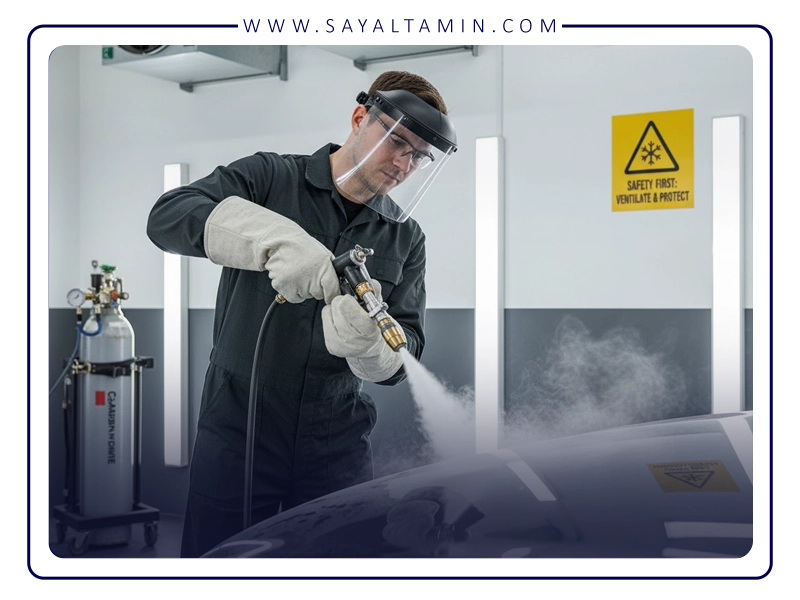
Although CO₂ is non-flammable and chemically inert, due to its extremely low temperature in the solid or liquid state, the following safety precautions are essential:
• Use gloves and safety glasses when working with dry ice or direct gas spray.
• Ensure proper ventilation of the work environment to prevent gas accumulation in closed spaces.
• Avoid direct contact with the skin, as low temperatures can cause frostbite.
• Use standard equipment and accurate pressure gauges when working with gas cylinders.
Industrial application and global trend of using CO₂ in body repair
In European and American countries, the use of CO₂ in conjunction with mechanical PDR is rapidly growing. Many insurance companies in these countries have accepted CO₂ repair as an official and low-cost method of hail damage compensation.
In the automotive industry, some factories use similar technology on quality control lines to repair minor dents that occur during assembly without repainting.
In Iran, in recent years, specialized paintless smoothing workshops have gradually been using this technology, especially in cold regions where hail damage is more common.
The effect of CO₂ temperature on various car body metals
One of the key points in the carbon dioxide dent repair method is knowing how different metals react to temperature changes. Each type of metal has a critical temperature range where its molecular structure undergoes significant contraction or expansion. Understanding this behavior allows the repairer to precisely adjust the intensity of the heat and cold applied, preventing any potential damage.
Thin steel, which is used in many economy cars or body parts such as roofs and doors, undergoes controlled deformation in the temperature range of about 50 to 80 degrees Celsius. When CO₂ gas is sprayed onto its hot surface, the metal contracts rapidly and returns to its original shape. This type of steel has a uniform response to sudden cooling, and the surface is usually smooth after the treatment without the need for additional mechanical modification.
Aluminum behaves differently. It is lighter and has a higher heat transfer coefficient than steel, so it reacts more quickly to temperature changes in the range of 40 to 65 degrees Celsius. When CO₂ is suddenly sprayed onto a hot section of aluminum, it contracts very quickly, often resulting in immediate surface repair. The upside is that aluminum is very unlikely to discolor or cause thermal effects on the paintwork.
More care is needed with galvanized steel — which is coated with a layer of zinc (Zn) to resist corrosion. This type of metal typically responds best to temperature changes between 55 and 75 degrees Celsius. The cold of CO₂ causes a gentle but effective contraction of the metal, without damaging the protective zinc coating. The end result is usually a perfectly smooth surface, with no need to recoat.
Finally, light alloys such as magnesium alloys or combinations of aluminum and silicon, due to their different crystal structure, have a weaker response to sudden cold. These materials undergo significant changes in the range of 45 to 60 ° C, but to achieve the desired result, it is necessary to allow a slightly longer heating time before applying CO₂ gas to ensure uniform shrinkage.
In general, it can be said that a precise understanding of the thermal properties of each type of metal is the key to success when using CO₂ to repair hail damage. The more precisely the temperature control, the greater the likelihood of a complete return to the surface and the lower the risk of discoloration or cracking.
Technical limitations and considerations
Although the CO₂ method has significant advantages, there are also limitations that must be considered:
• In very deep dents or with paint fractures, this method alone is not sufficient.
• In older bodies where paint or coating has poor adhesion, sudden cold may cause cracking.
• There is a need for technician experience and skill to determine the appropriate temperature and contact time.
• Improper use of gas can cause excessive thermal shock and change the structure of the metal.
The future of CO₂ technology in automotive repair
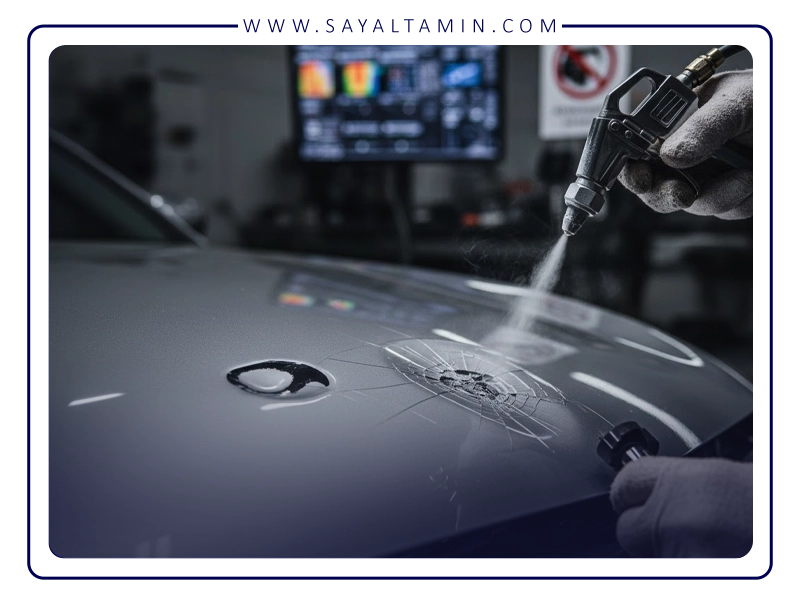
Recent advances in precise temperature control and gas spray equipment design have led automotive companies to pursue wider use of the technology. The combination of intelligent temperature sensing systems and thermal imaging cameras has enabled automatic adjustment of gas and heat levels. In the future, we may see fully automated CO₂ hail repair machines that can scan and repair the vehicle surface without manual intervention.
Also, the development of multi-stage and adjustable nozzles for more precise gas spraying will increase the efficiency of this method in various car body models.
| Read more: Use of carbon dioxide (CO₂) in medicine |  |
The use of carbon dioxide in hail damage repair combines physics, materials engineering, and new technologies in the automotive industry. This method uses controlled thermal contraction of the metal to restore the body’s original shape without the need for paint or putty.
High speed, low cost, preservation of original color, and environmental friendliness are some of its most important advantages. With increasing awareness among car owners and the expansion of specialized equipment in workshops, this technology is expected to become a universal standard in car body repairs in the coming years.
————————————————–
References
1. Paintless dent repair (PDR). Wikipedia.
2. Trends in Paintless Dent Repair. Vale Training Solutions Whitepaper.
www.valetrainingsolutions.com
3. The Science of Dent Repair: Precision Techniques for Flawless Results. Piedmont Dent Repair.
www.piedmontdentrepair.com
4. Dry Ice vs Paintless Dent Repair. CavCoach Automotive Blog.
www.cavcoach.co.uk
5. Unusual Dry Ice Uses: Fixing Dents and Hail Damage. Dry Ice Corp.
www.dryicecorp.com
6. Mastering Dent Removal: Expert Tips and Techniques. Fort Mill Hyundai Blog.
www.fortmillhyundai.com