
This post is also available in: Persian Armenian
With rising energy demand and increasing environmental pressures, energy-intensive industries are seeking solutions that both reduce fuel consumption and minimize pollutant emissions. Conventional flame-based combustion, while widespread, has significant limitations, including the production of nitrogen oxides (NOx), localized hot spots, and uneven heat distribution.
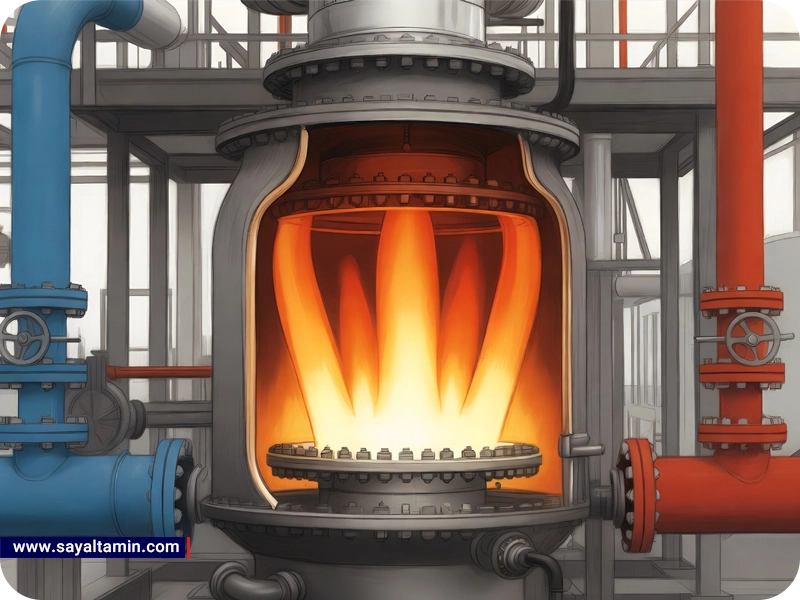
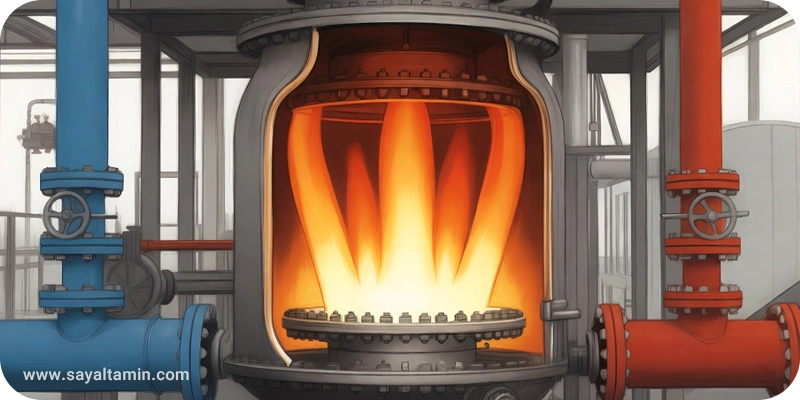
Flameless Oxidation systems, as an advanced solution, address many of these challenges. In this technology, the fuel–oxygen mixture is carefully controlled so that reaction and combustion temperatures are uniformly distributed throughout the flow volume, without forming a visible flame. The result is a significant reduction in NOx formation, improved heat transfer efficiency, and enhanced overall energy performance.
Iran, with its abundant gas condensate resources and extensive energy-intensive industries, has strong potential for the adoption of this technology. The use of high-purity oxygen provides optimal conditions for uniform combustion, enabling reduced fuel consumption and mitigating environmental impacts.
The Role of Oxygen in Flameless Oxidation
Oxygen, as one of the key elements in combustion processes, plays a decisive role in the performance and efficiency of flameless oxidation systems. In this advanced technology, the primary goal is to achieve uniform and stable combustion throughout the flow volume, without creating visible flames or hot spots. This characteristic significantly reduces nitrogen oxide (NOx) emissions and improves energy efficiency. The role of oxygen in this system can be examined from several perspectives:
1. Uniform Thermal Stabilization
In conventional combustion systems, fuel and air enter the combustion chamber at fixed ratios, producing concentrated flames where the temperature spikes locally. These hot spots not only reduce equipment lifespan but also generate high amounts of NOx.
In contrast, using high-purity oxygen in Flameless Oxidation allows fuel to oxidize slowly and uniformly. By carefully controlling temperature and reaction rate, local peak temperatures are eliminated, and heat is distributed evenly throughout the flow. This process not only increases thermal efficiency but also reduces equipment wear.
2. Pollution Reduction and Environmental Protection
Oxygen directly contributes to reducing pollutant formation. In traditional combustion, high flame temperatures and localized hot spots cause atmospheric nitrogen to react with oxygen, forming NOx. These pollutants have environmental impacts and can create legal and operational costs for industrial energy sectors.
In Flameless Oxidation, precise control of the fuel-to-oxygen ratio and uniform temperature distribution minimizes NOx formation. Industrial studies show that NOx emissions in these systems can be reduced by 70–90% compared to conventional combustion.
3. Fuel Optimization and Efficiency Improvement
High-purity oxygen ensures that fuel oxidizes with maximum efficiency. In traditional systems, some energy is lost due to incomplete combustion or local hot spots.
Flameless Oxidation converts all released fuel energy into useful heat uniformly, reducing fuel consumption per energy unit. This offers a significant economic advantage, particularly in Iran’s energy-intensive industries with valuable fossil fuel resources.
4. Process Stability and Reduced Fluctuations
Traditional combustion systems often face instability and unexpected shutdowns. Using pure oxygen in Flameless Oxidation stabilizes the combustion flow and reduces fluctuations. This is especially important in power plants and large industrial facilities where temperature consistency and continuous energy production are critical.
5. Practical Applications in Iran’s Energy-Intensive Industries
In Iran, energy-intensive sectors include power plants, refineries, and petrochemical industries where energy efficiency and pollutant control are critical. High-purity oxygen in Flameless Oxidation systems can:
- Optimize natural gas and gas condensate consumption,
- Reduce pollutant emissions and support environmental compliance,
- Extend the lifespan and performance of boilers and industrial furnaces.
For example, pilot tests in some Iranian steam power plants using natural gas-fired furnaces show that replacing conventional combustion with Flameless Oxidation and supplying pure oxygen can reduce fuel consumption by up to 15% and NOx emissions by up to 80%.
Design and Operation of Flameless Oxidation Systems in Iran
Flameless Oxidation systems fundamentally differ from traditional combustion methods. Unlike older systems where fuel and air enter rapidly and uncontrolled, creating localized flames and hot spots, Flameless Oxidation aims to achieve a uniform and controlled energy flow. Fuel and oxygen are injected with high precision, ensuring complete mixing and controlled turbulence so that combustion reactions occur homogeneously throughout the chamber.
This uniformity improves thermal efficiency, extends equipment lifespan, and drastically reduces harmful emissions like NOx. Using high-purity oxygen is pivotal; unlike conventional combustion that uses air and introduces large volumes of inert nitrogen, Flameless Oxidation allows controlled temperature and reaction rates. This prevents hot spots, optimizes fuel usage, and enhances overall energy efficiency.
Another critical feature is the uniform control of temperature and pressure within the combustion chamber. In traditional systems, sudden hot spots can cause severe thermal stress, risking equipment failure. Flameless Oxidation distributes heat evenly, reducing thermal stresses and maintaining process stability, allowing large facilities like power plants and refineries to operate safely and continuously.
Practical Benefits in Iran’s Energy Sector
Iran’s valuable natural gas and condensate resources benefit greatly from Flameless Oxidation. This technology enables efficient utilization of gas condensates, reduces fuel consumption, and minimizes pollutant emissions. For instance, in steam power plants using natural gas, replacing conventional combustion with Flameless Oxidation and high-purity oxygen can significantly boost thermal efficiency while cutting NOx emissions by 70–80%.
Fuel and oxygen flow management is highly specialized; the fuel-to-oxygen ratio, injection rate, and mixing quality determine combustion efficiency. Engineers must monitor temperature and flow in real-time using sensors and digital control systems to maintain optimal, stable conditions. This level of control enables large-scale industrial adoption while preventing fluctuations or unplanned shutdowns.
Flameless Oxidation is not only an advanced energy efficiency technology but also a powerful tool for environmental protection, particularly when combined with Iran’s gas condensates. It contributes to a sustainable, cost-effective energy cycle and enhances the competitive advantage of domestic industries.
Advantages, Limitations, and Development Outlook
Flameless Oxidation offers substantial economic and environmental benefits. Its primary advantages include:
- Significant reduction of nitrogen oxide emissions: By eliminating localized hot spots and using pure oxygen, NOx formation decreases by 70–90%, reducing environmental impacts and operational costs.
- Optimized fuel consumption: Uniform heat distribution prevents energy loss, raising overall system thermal efficiency. This is crucial for Iran’s energy-intensive industries dependent on gas and condensates.
- Process stability and equipment longevity: Even heat and pressure distribution reduces wear and thermal stress, lowering maintenance costs.
Limitations: The technology requires high-purity oxygen and advanced control systems. Supplying quality oxygen at large scales and maintaining precise combustion chamber and fuel-oxygen injection design demand skilled engineering. However, with proper planning, training, and infrastructure, these challenges are manageable.
Outlook: With growing energy industries, environmental pressures, and the need for higher efficiency, Flameless Oxidation can play a key role in industrial transformation. Coupled with Iran’s rich gas condensate resources, it enables a sustainable, low-cost, low-emission energy cycle while enhancing domestic industrial competitiveness. Future developments in simulation software and intelligent process control systems will further facilitate its adoption and help establish Flameless Oxidation as a new standard in Iran’s energy sector.
Comparison Table: Conventional Combustion vs. Flameless Oxidation
| Feature | Conventional Combustion | Flameless Oxidation |
|---|---|---|
| Flame Presence | Visible, concentrated flame creating hot spots | No visible flame, uniform heat throughout the chamber |
| Temperature Distribution | Uneven, hot and cold spots | Uniform, no local temperature peaks |
| Thermal Efficiency | Lower due to energy loss at hot spots | Higher, fuel energy converted optimally to useful heat |
| Pollutant Emissions (NOx) | High due to high flame temperatures | Very low, 70–90% reduction compared to conventional |
| Fuel Consumption | Higher due to incomplete combustion and energy loss | Optimized, 10–15% reduction |
| Process Stability | Unstable, risk of sudden shutdowns | Stable, uniform and controlled flow |
| Equipment Lifespan | Reduced due to thermal stress and wear | Increased, reduced thermal stress and wear |
| Control Equipment Requirement | Minimal, simple system | High, precise control of fuel-oxygen flow and temperature |
| Environmental Benefit | Limited, high pollutant production | High, reduced emissions and compliance with environmental standards |
Flameless Oxidation has fundamentally transformed Iran’s energy-intensive industries. By precisely injecting high-purity fuel and oxygen, this technology minimizes conventional combustion issues such as hot spots, energy loss, and NOx formation. Uniform temperature and pressure distribution increases thermal efficiency, extends equipment life, and reduces maintenance.
High-quality oxygen ensures fuel oxidizes smoothly and uniformly, stabilizing the combustion process. This optimizes fuel use, reduces emissions, and enhances overall system efficiency, making Flameless Oxidation a highly suitable technology for Iran’s energy sector. Despite requiring high-purity oxygen and advanced control systems, its clear economic, environmental, and operational benefits make it a compelling alternative to traditional combustion.
With further development of smart control systems and simulation software, maximum adoption in large-scale and sensitive industries is expected. The outlook for Flameless Oxidation in Iran is highly positive, promising a sustainable, cost-effective, low-emission energy cycle while boosting domestic industrial competitiveness. Ultimately, Flameless Oxidation is not just an advanced technology—it is a practical, economical, and environmentally responsible solution that can set a new standard in Iran’s energy-intensive industries.
————————————————–
resource
Jiang, Y., et al. (2020). Flameless Oxidation: Principles and Industrial Applications. Journal of Energy Engineering, 146(5), 04020050.
Cengel, Y. A., & Turner, R. H. (2015). Fundamentals of Thermal-Fluid Sciences. McGraw-Hill Education.
Rizk, F., et al. (2019). Advanced Combustion Technologies: Flameless Oxidation in Power Plants. Energy Conversion and Management, 199, 111998.
Gülder, Ö. L., & Snijders, G. (2018). Flameless Combustion in Industrial Furnaces: A Review. Progress in Energy and Combustion Science, 64, 1–27.
IEA (International Energy Agency). (2021). Clean Combustion Technologies for Industrial Applications. Paris: IEA Publications.