

This post is also available in: Persian Armenian
With the escalating global demand for clean energy and the shift away from fossil fuels, advanced solar technologies have become a central focus for researchers and industry alike. Perovskite solar cells, due to their unique crystalline structure and high light-absorption capabilities, have achieved energy conversion efficiencies approaching those of silicon-based solar cells in less than a decade. This rapid progress has positioned industrial-scale production of perovskite cells as a strategic objective in the energy sector.
However, the industrial-scale manufacturing of perovskite cells presents complex, multifaceted challenges. Perovskite materials—especially metal halides such as lead halides—are highly sensitive to oxidation and moisture. Even trace amounts of oxygen can disrupt the crystal lattice, resulting in defects and reduced efficiency. Under such conditions, precise environmental control, the use of inert gases, and the creation of a neutral atmosphere become critical.
Argon, with its unique properties—including chemical inertness, higher density than air, and the ability to form a protective atmosphere at elevated temperatures—has become a key tool in industrial perovskite cell production. Argon is widely used in deposition chambers, thermal processing, and thin-film coating operations, playing a vital role in preventing contamination, ensuring layer uniformity, and improving final cell efficiency. Compared to other protective gases, such as nitrogen, argon offers finer control over thermal and chemical conditions, which is essential for large-scale, high-quality production.
Physical and Chemical Properties of Argon and Its Importance in Perovskite Cell Manufacturing
Argon, a member of the noble gas family, possesses unique characteristics that make it indispensable in oxidation- and contamination-sensitive industries. As a chemically inert gas, argon remains nonreactive even at high industrial processing temperatures, serving as a natural protective barrier for sensitive materials.
In perovskite solar cell production, this property is particularly important. Despite their numerous advantages, perovskite cells are extremely sensitive to moisture, oxygen, and impurities. Even minimal oxygen exposure can disrupt their crystal structure, reducing both efficiency and lifespan. Here, argon creates a completely neutral and safe environment for critical processes.
One notable physical property of argon is its higher density than air, which allows the gas to form a protective layer over sensitive materials during flow in production environments. This acts as an invisible shield, preventing direct contact with atmospheric oxygen and moisture.
Low thermal conductivity is another benefit of argon in perovskite production. In deposition and thermal treatment processes, precise temperature control directly affects crystal growth and film uniformity. Argon’s low thermal conductivity enables stable and controlled conditions, allowing perovskite layers to form and grow without defects.
From a practical perspective, argon serves as both a carrier and protective gas in deposition techniques like PVD and CVD or in thermal chambers under inert atmospheres. This ensures that materials are applied accurately and uniformly, which is critical for industrial-scale production of high-quality cells. Without argon, even precise temperature and pressure controls cannot fully prevent oxygen or moisture intrusion, compromising the final product quality.
Additionally, argon allows manufacturers to maintain a stable and safe environment while improving cell yield and minimizing losses from crystalline defects. In other words, argon is not just a protective gas—it is a key factor in ensuring quality, uniformity, and longevity of perovskite solar cells, making its role in industrial production indispensable.
Practical Applications of Argon in Industrial Perovskite Cell Production and Its Impact on Quality and Efficiency
In industrial perovskite solar cell production, argon goes beyond being a simple protective gas; it acts as the backbone of the production environment, covering all sensitive steps. From raw material preparation to final crystal formation, argon invisibly but critically ensures maximum product quality.
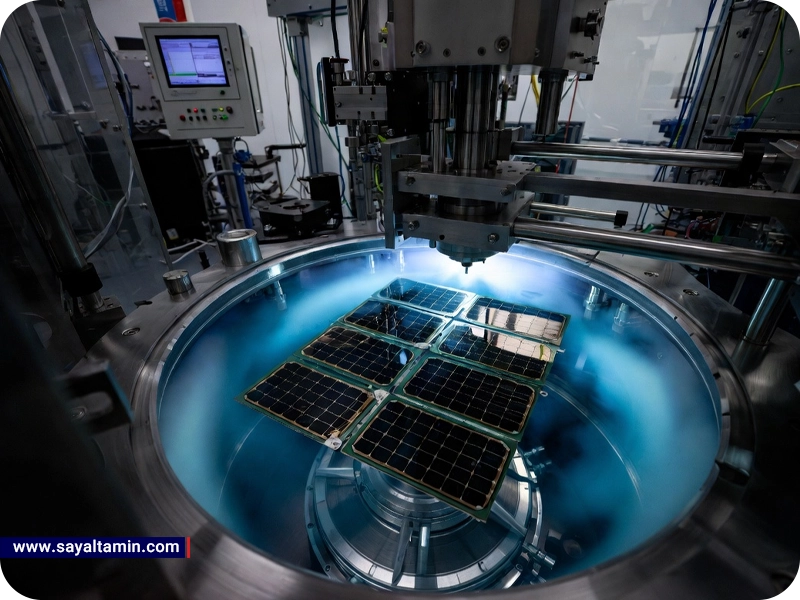
Neutral Atmospheres in Deposition Chambers: Argon is primarily used to create inert atmospheres in deposition chambers. Here, perovskite materials are placed on specialized substrates, and processes such as evaporation, deposition, and thermal treatment begin. Even trace oxygen or moisture can disrupt crystal structures, causing voids, cracks, and localized defects. Argon forms a protective layer that prevents these intrusions, providing a stable environment for crystal growth.
Temperature Control and Heat Distribution: Argon’s low thermal conductivity allows precise maintenance of substrate temperature without overheating or cooling hotspots. This ensures uniform layer thickness and ordered crystal growth, directly improving solar cell efficiency.
Carrier Gas in Advanced Deposition Techniques: In PVD and CVD processes, argon also serves as a carrier gas, guiding evaporated materials or reactants uniformly onto substrates. This prevents unwanted accumulation, discontinuities, or bubbles. Without such control, produced cells would not only have lower efficiency but also reduced longevity.
Reducing Waste and Improving Yield: In industrial production, minor crystal defects or trapped air bubbles can lead to product loss. Continuous argon use allows manufacturers to maximize high-quality output and reduce waste and operational costs. This economic advantage, combined with improved technical performance, makes argon a key component of the industrial production chain.
Long-Term Stability: Argon also ensures that perovskite cells maintain stable performance and durability. Cells produced under argon-controlled conditions exhibit higher efficiency and better resistance to environmental stressors like moisture and oxygen—critical for industrial and commercial applications requiring long-term reliability.
Table: Role of Argon in Industrial Perovskite Solar Cell Production
| Argon Property | Application in Perovskite Cell Production | Impact on Quality and Efficiency |
|---|---|---|
| Chemical Inertness | Creating neutral atmospheres in deposition chambers and thermal processes | Prevents oxidation and crystal degradation; maintains layer integrity |
| Higher Density than Air | Forms protective layer over sensitive materials | Blocks oxygen and moisture ingress; reduces localized defects |
| Low Thermal Conductivity | Precise temperature control in thermal and deposition processes | Ensures uniform layer thickness, orderly crystal growth, and higher cell efficiency |
| Material Carrier in PVD/CVD | Guides evaporated materials or reactants onto substrate surfaces | Produces uniform, dense layers; reduces discontinuities and bubbles |
| Long-Term Stability | Industrial-scale mass production | Increases yield, reduces waste, improves performance stability and cell lifespan |
Challenges and Limitations of Using Argon in Industrial Perovskite Cell Production
Despite argon’s numerous benefits, its industrial use comes with challenges and limitations. Awareness of these factors is critical for optimal process design and cost management.
High Cost: Argon is more expensive than other protective gases, such as nitrogen. Producing and supplying argon at industrial purity requires specialized equipment and processes, increasing initial investment and operational costs, particularly in large-scale production. However, these costs are often offset by higher efficiency and lower waste, provided resources are carefully managed.
Flow and Pressure Control: Effective inerting requires precise argon flow control. Too little argon may not provide sufficient protection, while excessive flow can disrupt layer deposition or waste gas. Advanced monitoring and control systems are necessary to maintain this delicate balance.
Specialized Storage and Distribution Equipment: High-pressure tanks, leak-proof distribution lines, and advanced safety systems are essential to ensure high-purity argon reaches the process without contamination. Any system failure can compromise perovskite layer quality.
Temperature and Atmospheric Sensitivity: Some perovskite layers remain sensitive to temperature and atmospheric conditions even in argon. While argon provides a neutral environment, producing high-quality thin films still requires precise temperature, humidity, and timing control. Argon is necessary but not sufficient; it must be integrated with other process parameters.
Nevertheless, industrial experience shows that with smart system design and optimal argon usage, a balance between cost, quality, and efficiency can be achieved, making argon use a practical standard in perovskite solar cell manufacturing.
Future Outlook and Innovations in Argon Use for Perovskite Solar Cells
The perovskite solar cell industry is undergoing a remarkable transformation, and argon plays an undeniable role. With increasing global demand for clean energy and the shift toward industrial-scale mass production, the need for stable, controlled environments has never been greater. Argon, with its unique properties, is recognized not only as a protective gas but also as a key element in process innovation and engineering.
Integration with Advanced Deposition and Automation: Innovative approaches include integrating argon with advanced deposition technologies and production automation. Using sensors to monitor flow, pressure, and purity allows for highly precise control of production environments. This results in more stable cells with higher efficiency and longer lifespans, enabling manufacturers to meet global industrial and commercial standards.
Combined Atmosphere Studies: Research is exploring the combined effects of argon with other protective gases or atmospheric additives. Smart combinations of argon with nitrogen or hydrogen in certain processes can significantly improve film quality and cell efficiency without introducing additional risk or operational complexity. This approach could mark a turning point in industrial production and commercialization of perovskite solar cells.
Scalability: Argon facilitates scaling from laboratory to industrial production, providing a neutral, controlled environment to produce high-quality, high-yield cells consistently. This makes argon essential for expanding perovskite technology globally.
————————————————–
resource
1. Enhancing 2D/3D heterointerface via argon plasma polishing for efficient perovskite solar cells
2. Perovskite solar cell built through argon plasma treatment achieves 23.55% efficiency
3. Argon Plasma Treatment to Tune Perovskite Surface Composition for High Efficiency Solar Cells
4. Fabrication of efficient perovskite films by chemical vapor deposition using argon as carrier gas
5. Gas quenching with helium, argon for more stable perovskite solar cells
6. Effect of Annealing in ITO Film Prepared at Various Argon-and-Oxygen-Mixture Ratios via Facing-Target Sputtering