This post is also available in: Persian Armenian
Argon is a chemical element with the symbol Ar and atomic number 18. It belongs to Group 18 of the periodic table and is classified as a noble gas. In terms of abundance, Argon ranks twelfth among chemical elements, comprising 0.934% of Earth’s atmosphere, making it the third most abundant gas in the atmosphere. Its abundance is more than twice that of water vapor (H₂O), 23 times greater than carbon dioxide (CO₂), and over 500 times more abundant than neon (Ne). It is worth noting that Argon is the most abundant noble gas, constituting 0.00015% of the Earth’s crust. Argon makes up 1.288% by weight and 0.934% by volume of the atmosphere and is trapped in rocks.
The Argon present in the atmosphere has been gradually increasing since the formation of Earth, taking about 4.5 billion years to accumulate a small amount in the atmosphere. The formation of Argon occurs when potassium (40) in rocks undergoes radioactive decay, a process known as radiometric decay. Additionally, this element is present in small amounts in the Earth’s crust and ocean water, besides the amount found in the atmosphere. Argon atoms are mechanically trapped in cavities and cages of other molecules, such as ice crystals or the organic compound hydroquinone.
The word “Argon” is derived from the Greek word (ἀργόν, neuter singular form ἀργός), meaning “inactive” or “lazy,” referring to the fact that this element does not participate in chemical reactions. Argon’s reluctance to engage in chemical reactions is due to its complete octet (eight electrons) in the outer atomic shell, making it stable and resistant to bonding with other elements.
History and Production of Argon Gas
Argon gas was first isolated from air in 1894 by British scientists Lord Rayleigh and Sir William Ramsay. In 1785, Henry Cavendish, while investigating atmospheric nitrogen, concluded that a portion of nitrogen might be composed of some inert components. His work was forgotten until Lord Rayleigh, more than 100 years later, discovered that pure nitrogen (obtained by removing oxygen) always had about 0.5% more density than nitrogen from chemical sources such as ammonia. After removing oxygen and nitrogen, a heavier gas remained from the air, which was the first noble gas discovered on Earth. Because of its chemical inertness, the Greek word “argos,” meaning “lazy,” was used to name it.
Argon is the second member of a group of gases known as “noble,” “inert,” or “rare gases.” Other gases in this group include helium (He), neon (Ne), krypton (Kr), xenon (Xe), and radon (Rn). These gases are monoatomic, and their outermost electron shells are completely filled. The terms “noble” and “inert” refer to their lack of chemical reactivity with other elements. All members of this group emit light when electrically excited; Argon’s electrical discharge emits a pale red color at low pressure and a steel-blue hue at high pressure.
Argon is approximately as soluble in water as oxygen and 2.5 times more soluble than nitrogen. Due to its general inertness, especially at high temperatures, Argon holds significant value.
Properties of Argon Gas

Property | Value |
Atomic Number (Number of Protons) | 18 |
Atomic Symbol (in the Periodic Table) | Ar |
Atomic Weight (Average Atomic Mass) | 39.948 |
Density | 0.0017837 g/cm³ |
Phase at Room Temperature | Gas |
Odor | Odorless |
Color | Colorless |
Flammability | Non-flammable |
Toxicity | Non-toxic and inert |
Melting Point | -308.83°F (-189.35°C) |
Boiling Point | -302.53°F (-185.85°C) |
Number of Isotopes (Atoms of an element with different numbers of neutrons) | 25; 3 stable |
Most Common Isotopes | Ar-40 (99.6035% natural abundance), Ar-38 (0.0629% natural abundance), Ar-36 (0.3336% natural abundance) |
Argon Production in Industry
Argon is produced industrially through partial distillation of liquid air in a cryogenic air separation unit. In this process, liquid nitrogen (boiling at 77.3 K) and liquid oxygen (boiling at 90.2 K) are separated from argon, which boils at 87.3 K. It is noteworthy that argon’s boiling point is very close to that of oxygen (with only a 5.3°F or 2.9°C difference), so separating pure argon from oxygen requires many distillation stages. Through this method, approximately 700,000 tons of argon are produced annually worldwide.
Applications of Argon Gas
- Heat Treatment, Steel, and Iron Manufacturing:
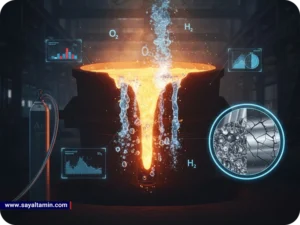
During steel manufacturing in a converter, oxygen and argon are blown into molten metal. Adding argon reduces chromium loss and produces the desired carbon content at lower temperatures. In high-quality steel production, argon is used as a purging gas to prevent nitride formation. - Casting and Aluminum Production:
Argon is used as a shielding gas in casting and in aluminum production to assist in degassing and removing hydrogen and dissolved particles from molten aluminum. - High-Temperature Industrial Processes:
Argon is used in specific high-temperature industrial processes where reactive materials become reactive. For example, preventing the combustion of graphite by using argon in electric graphite furnaces. - Fire Extinguishing:
Argon is sometimes used to extinguish fires in areas with valuable equipment that may be damaged by water or foam. - Inert Gas for Sensitive Equipment:
Argon may be preferred over nitrogen in cases where nitrogen could react with reagents or equipment in glove boxes or other specialized settings (even though nitrogen is cheaper). - Gas Chromatography and Mass Spectrometry:
Argon can be used as a carrier gas in gas chromatography (GC) and electrospray ionization mass spectrometry (ESI-MS). It is also used in ICP (Inductively Coupled Plasma) spectroscopy. - Light Bulbs:
Argon-filled incandescent bulbs preserve filaments from oxidation at high temperatures. Argon-filled bulbs with mercury produce blue light, while pure argon produces purple light. - Thermal Insulation:
Argon is used as thermal insulation in double-glazed windows. Adding argon to the air mixture in the insulating gap enhances the insulation value of the glass, making it more energy-efficient. - Tire Inflation:
Surprisingly, argon is used for inflating tires in luxury cars. - Welding:
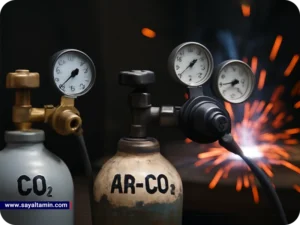
Argon is a shielding gas in welding that protects the weld from oxygen or water interference and produces a cleaner weld with increased arc stability. It is essential in Tungsten Inert Gas Welding (TIG). - Medical Uses:
Argon is used in laser technologies for medical applications, such as in excimer lasers for LASIK surgery. - Brain Injury Treatment:
Noble gas xenon has been researched for brain injury treatment. Due to its scarcity and high cost, researchers have turned to argon as a potential substitute. - Cryosurgery:
Liquid argon is used in cryosurgery to selectively destroy abnormal tissues, especially on the skin or cancerous cells. The technique involves directing liquid argon via a cryoneedle, providing better control than previous methods using liquid nitrogen. - Laser Surgery:
Argon blue lasers are used in surgeries to weld blood vessels, remove tumors, and correct eye defects. - Poultry Industry:
Argon is used in the poultry industry for the humane culling of birds, particularly in disease outbreaks. Due to its higher density, argon displaces oxygen, causing asphyxiation. - Food Preservation:
Argon replaces oxygen and moisture in food packaging to extend shelf life. The European food additive code for argon is E938. - Diving:
In technical diving, argon is used for dry suit inflation due to its inertness, low thermal conductivity, and non-reactivity. - Athletes:
Argon is used by athletes as a doping agent to simulate hypoxic conditions. In 2014, the World Anti-Doping Agency (WADA) added argon and xenon to the list of prohibited substances.
Health Hazards and Industrial Safety of Argon Gas
Despite argon being chemically inert, colorless, odorless, and non-toxic, it can present serious risks in certain environments, particularly in confined spaces or cryogenic processes.
- Asphyxiation Risk in Confined Spaces:
The primary danger of argon is asphyxiation in confined, poorly ventilated spaces. Being denser than air, argon can displace oxygen, leading to reduced oxygen levels in the environment.
Symptoms:- Initial symptoms: headache, dizziness, fatigue, nausea
- At high concentrations: loss of consciousness, unconsciousness, and death within minutes
Even slow leakage from a cylinder in small, enclosed spaces can cause dangerously low oxygen levels.
- Chemical Inertness ≠ Safety:
While argon does not engage in chemical reactions, it can still act as a physical asphyxiant at high concentrations. This places it in the same category as nitrogen and helium, which can cause oxygen depletion without any warning. - Hazards of Liquid Argon (LAr):
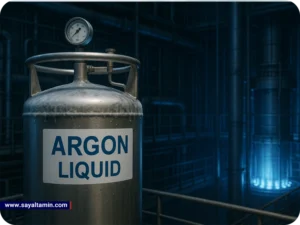
Liquid argon, with a boiling point of about -185°C (-302°F), belongs to the cryogenic gases category. Contact with liquid argon can lead to:- Severe frostbite on skin or eyes
- Deep tissue damage from direct contact
- Cryogenic burns or ruptured blood vessels at the contact site
- Increased vapor pressure in improperly stored tanks
- Storage and Handling Hazards:
- Cylinder explosion due to increased temperature or mechanical impact
- Slow leaks that can go unnoticed and accumulate in low areas
- Damage to equipment from contact with extremely cold liquid argon
To reduce these hazards, use safety equipment like: - Adequate ventilation systems
- Gas leak detectors
- Cryogenic gloves, masks, safety glasses, and protective clothing
- Safety and Health Classification:
Property | Status |
Flammability | Non-flammable |
Toxicity | Non-toxic |
Asphyxiation | Severely asphyxiating at high concentrations |
Skin Contact | Safe (gas), hazardous (liquid) |
Environmental Hazard | None |
European Code Standard | E938 (for food industries) |
Safety Recommendations for Working with Argon Gas
- Never use argon in enclosed or poorly ventilated spaces.
- Monitor gas leaks with a detector and take any leakage seriously.
- Use cryogenic equipment when working with liquid argon.
- Always follow Safety Data Sheets (SDS) and guidelines.
- Avoid storing cylinders at high temperatures or in direct sunlight.
Isotopes of Argon Gas
What is an Isotope?
Isotopes are atoms of the same element that have the same number of protons but different numbers of neutrons. This difference in neutrons results in various nuclear properties, such as stability, radioactive decay, or specialized applications.
Stable Isotopes of Argon
Naturally, argon has three stable isotopes that together constitute 100% of natural argon:
Isotope | Natural Abundance | Characteristic |
Argon-36 (³⁶Ar) | About 0.34% | The lightest stable isotope |
Argon-38 (³⁸Ar) | About 0.06% | The rarest stable isotope |
Argon-40 (⁴⁰Ar) | About 99.6% | The most common natural isotope of argon |
Important Scientific Note
The Argon-40 (⁴⁰Ar) isotope is produced through the radioactive decay of Potassium-40 (⁴⁰K) in the Earth’s layers, which is why it is abundant in the Earth’s atmosphere.
Unstable (Radioactive) Isotopes of Argon
In addition to the stable isotopes, several unstable (radioactive) isotopes of argon exist, which are typically produced in specific environments or laboratories. The most important of these are:
Isotope | Half-life | Application |
Argon-39 (³⁹Ar) | About 269 years | Groundwater and polar ice dating |
Argon-37 (³⁷Ar) | About 35 days | Detection of underground nuclear leaks |
Argon-42 (⁴²Ar) | About 33 years | Nuclear research and fusion modeling |
| Do you need Argon isotopes for specific applications? We are a supplier of high-purity Argon isotopes for medical, research, and industrial uses. call: +9809134490305 |
Applications of Argon Isotopes in Science and Industry
- Geology and Potassium-Argon (K-Ar) Dating
The Potassium-Argon method is one of the most accurate ways to date rocks and fossils. In this method, the amount of ⁴⁰Ar produced by the decay of Potassium-40 in minerals is measured to determine the age of the rock. This method is used to date volcanic rocks, extending back billions of years. - Groundwater Dating with Argon-39
The ³⁹Ar isotope is used in hydrogeology to date groundwater sources that are between 100 and 1,000 years old. This method helps assess renewable water resources and aids in the sustainable management of water supplies. - Nuclear Physics and Neutrino Detectors
In major scientific projects like particle physics laboratories (such as DUNE and DarkSide), specific Argon isotopes are used in neutrino detectors. Liquid Argon with special isotopes, due to its optical transparency and ionization properties, is one of the best options for detecting fundamental particles. - Nuclear Explosion Monitoring and Safety (Argon-37)
International monitoring organizations use the ³⁷Ar isotope to track underground nuclear weapon tests. This isotope is produced when neutrons collide with calcium in soil and serves as a marker for underground nuclear activity.
————————————————–
Sources:
————————————————–
✅ Are you ready to buy argon gas
We supply argon gas in various volumes with standard certification and fast delivery.