
This post is also available in: Persian Armenian
This article examines carbon dioxide in the foundry industry. Carbon dioxide (CO2) is one of the most important and significant gases in the foundry industry. Below, we examine the effects and applications of carbon dioxide in the foundry industry:
Application in the casting process
Use in the steel casting process:
In some steel casting processes, carbon dioxide is used as a gaseous agent. It is injected directly or as a component of a gas mixture into the casting furnace. The use of carbon dioxide in these processes can help control temperature, oxidize iron, and remove contaminants.
Use in the aluminum casting process:
In some aluminum casting processes, such as pressure casting, carbon dioxide is used as a shielding gas. This gas prevents the molten aluminum from coming into contact with the outside air and oxidizing it.
Application in cleaning processes:
Removing contaminants:
Carbon dioxide can be used as an oxidizing agent in cleaning processes. In the foundry industry, this gas may be used to remove pollutants such as sulfur oxides (SOx) and nitrogen oxides (NOx) that are produced as by-products in the foundry process.
Surface cleaning:
Carbon dioxide can be used in metal surface cleaning processes. This gas is used in processes such as pre-treatment and spraying to remove oil, surface contaminants and create a clean surface ready for subsequent processes.
What is the casting process like?
The casting process is a process for producing metal parts in which molten materials, usually metals, are injected into a mold or former, and after cooling, the final part is obtained.
Below we examine the main steps of the casting process:
Pattern Design
First, to make casting molds, you need an accurate model of the final part. The model can be made from a variety of materials, such as wood, metal, or plastic. The model must accurately represent the final shape and size of the part.
Mold Making
Based on the pattern, a casting mold is made. The mold is usually made of materials such as sand and silicone resin or steel. The mold must have the exact shape and size of the final part and be able to withstand the temperature and pressure of the molten material.
Read more about Carbon Dioxide in the Foundry Industry: Liquid Oxygen

Preparation of Molten Material
Molten materials, usually metals, are melted in a special furnace or mold. At this stage, additional materials such as alloys, cosmetic materials, and powdered waterproofing materials are added to the molten material to improve specific properties such as strength, hardness, and microstructure required for the part.
Casting
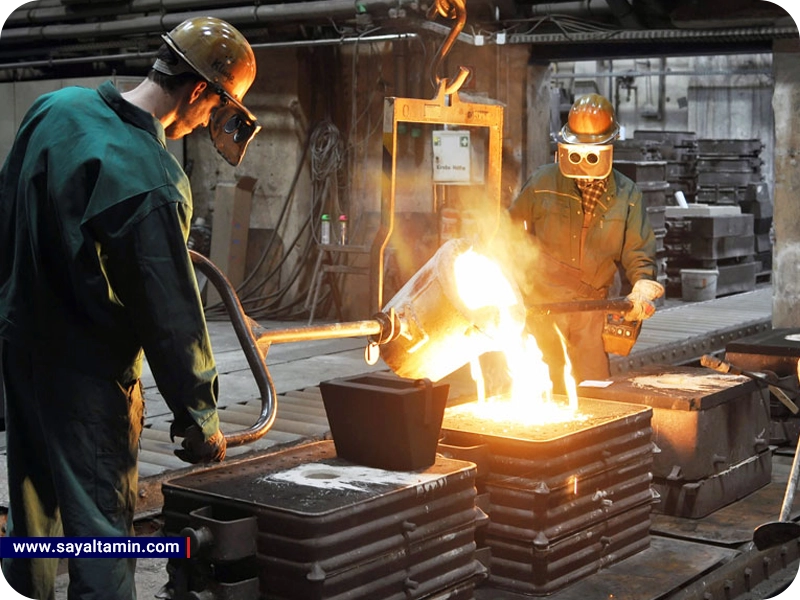
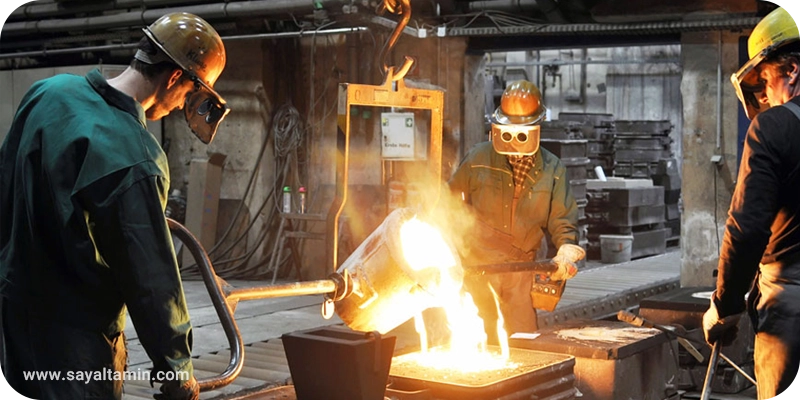
In this stage, molten material is injected into the mold using a sprue or casting machine. The molten material collects inside the mold and takes on the final shape of the part.
Cooling and Solidification
After casting, the part is cooled in the mold to solidify. The time it takes for the part to cool and solidify depends on its mass and thickness. The rate of cooling can also have a significant impact on the final properties of the part.
Demolding
After the part solidifies, the mold is opened and the part is removed from the mold. This process may be accomplished using tools, a blast of compressed air, or other methods.
Post-Processing
The cast part may require post-processing to achieve its final shape. This step includes operations such as cutting, cleaning, leveling, removing burrs and chips, drilling, and heat treating.
Inspection and Quality Control
The cast part is evaluated using inspection and quality control methods. This includes dimensional measurements, inspection of chip lines and roughness, non-destructive testing (such as dye testing, air pressure testing, radiographic testing, and ultrasonic testing), and mechanical property measurements.
After completing the above steps, the cast part is ready for use or enters the next stages of production.
Read more about Carbon Dioxide in the Foundry Industry: Liquid Nitrogen

Reasons for using carbon dioxide in casting
The use of carbon dioxide (CO2) in the casting process as a lubricating gas (as an alternative to air) can have some specific advantages and applications.
Better heat transfer flow:
Carbon dioxide has better thermal properties than air. Using CO2 instead of air improves the heat transfer rate in the casting process. This reduces the cooling time of the part and improves control of its final dimensions.
Reduces burn formation and oxidation:
In its standard form, carbon dioxide is non-combustible and reduces the oxidation process when it comes into contact with combustible materials. This property can be effective in preventing the formation of oxidation stains and corrosion on the surface of the cast part.
Reducing emissions of polluting gases:
Using CO2 instead of air can reduce the emission of polluting gases associated with the burning of combustible materials in the casting process. This helps improve the surface quality of the part and reduces the need for further post-processing.
More pressure control:
By using CO2 instead of air, the pressure inside the mold is more precisely controlled, allowing for casting parts with finer details.
Reducing the dimensions of the templates:
By using carbon dioxide instead of air, the need for larger and more complex molds is reduced. This can lead to savings in mold-making costs.
Carbon dioxide sand specifications
Carbon dioxide sand (CO2 sand), or sand saturated with carbon dioxide, may be used in laboratories or industrial processes. The particle size of carbon dioxide sand may vary and depends on the specific needs of the process or application. The particle shape can depend on factors such as the production method and how the sand is saturated with carbon dioxide. The physical properties of carbon dioxide, including density, residual moisture, and melting temperature, depend on the details of the production process and the type of sand used. The chemical properties of carbon dioxide sand can include CO2 absorption and other chemical changes.
The specifications of carbon dioxide sand may be highly dependent on the type of application or process it is used for. To obtain more detailed information about carbon dioxide sand, you can contact the chemical manufacturers or suppliers for specific information.
Read more about Carbon Dioxide in the Foundry Industry: Liquid Argon

How to store and inject carbon dioxide gas
Storing and injecting carbon dioxide (CO2) gas safely and effectively depends on the type of CO2 source and the purpose for which it is being used. Below we will examine two common methods for storing and injecting CO2:
Storage and injection in underground tanks:
One of the main methods of storing and injecting CO2 is in underground reservoirs, such as oil and natural gas reservoirs. This method is known as carbon capture and storage (CCS). In this method, CO2 produced by sources such as thermal and industrial power plants or industrial processes is captured from other gases using separation technologies and then stored in underground reservoirs.
Underground reservoirs can include pure oil and gas reservoirs, limestone reservoirs, shale reservoirs, etc. The depth and properties of the reservoirs depend on the geographical conditions of each region.
Storage and injection in industrial processes:
CO2 can be produced as a secondary output in some industrial processes and then stored and injected for various uses. For example, CO2 consisting of carbon dioxide produced in industrial processes such as ammonia production, petrochemical processes, fossil fuel-fired power generation units, etc. can be used as a source of CO2 for other uses by using separation technologies and storing it in special tanks or reservoirs.
These uses include use in other industrial processes, chemical production, monitoring agricultural processes, etc.
Where can we get carbon dioxide for the foundry industry?
A significant portion of the carbon dioxide produced comes from thermal power plants that burn fossil fuels such as coal or natural gas. In the fuel production process, CO2 is produced as a gaseous phase (for example, in the coal gasification process) or in the exhaust fumes of the power plant. This CO2 can be collected and used.
In some industrial processes such as ammonia production, petrochemical processes, steel and aluminum production, etc., CO2 is produced as a by-product. This CO2 can be used for foundry industries.
CO2 can be extracted from natural sources such as gas and oil wells. In some cases, CO2 is specifically used to extract other gases and can be collected and used from this process. There are other sources of CO2, including oil and gas refineries, food processing industries (such as beverage manufacturing), CO2 recovery systems, and more.
Gas supply companies usually supply CO2 in various forms (gaseous or liquid) in bulk or in bulk. These gases are supplied in compressed cylinders or in liquid form in containers (tankers).
In some factories, CO2 is produced as waste or from other production chains (such as thermal processes) and can be used locally for the needs of the foundry industry.
Gases usually supply CO2 in various forms (gaseous or liquid) in limited or bulk quantities. These gases are supplied in compressed cylinders or in liquid form in containers (tankers). In some plants, CO2 is produced as a waste or in other production chains (e.g. thermal processes) and can be used locally for the needs of the foundry industry.
Read more about Carbon Dioxide in Foundry Industries: Application of Oxygen in the Steel Industry

————————————————–
Resources: