
This post is also available in: Persian Armenian
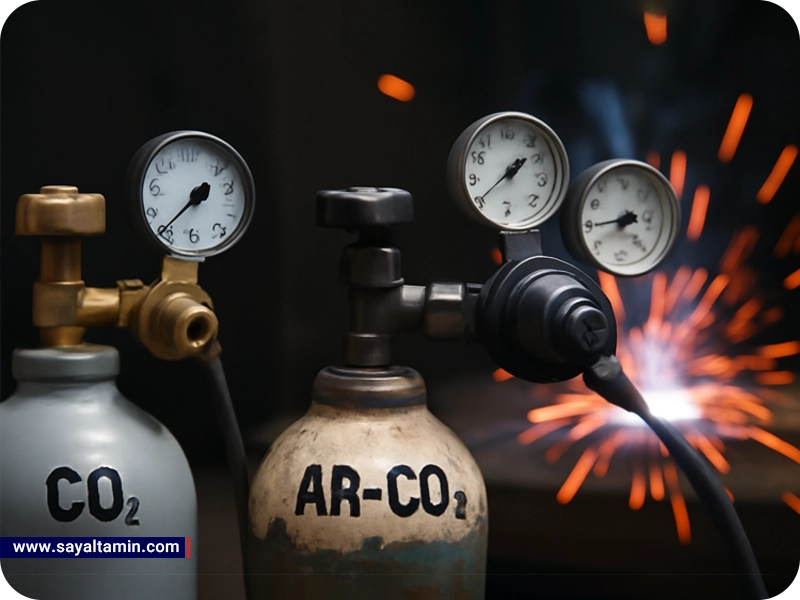
In the welding industry, the selection of the right shielding gas plays a decisive role in the final weld quality, process efficiency and related costs. In MIG/MAG welding processes used to join various metals, shielding gases are divided into two main categories: neutral gases (such as argon) and active gases (such as carbon dioxide). Among them, pure carbon dioxide (CO₂) and argon-carbon dioxide (Ar-CO₂) mixtures are the most widely used and common options for welding carbon and low-alloy steels.
In this article, we will comprehensively review the features, advantages, and disadvantages of each of these two types of shielding gas and provide key points for optimal selection in industrial projects.
Pure carbon dioxide (CO₂)
Carbon dioxide is one of the active gases that is widely used in various industries, especially in the welding of carbon steels, due to its low cost, availability, and special properties. This gas reacts with the molten metal during welding, which creates a stable welding arc and deeper penetration.
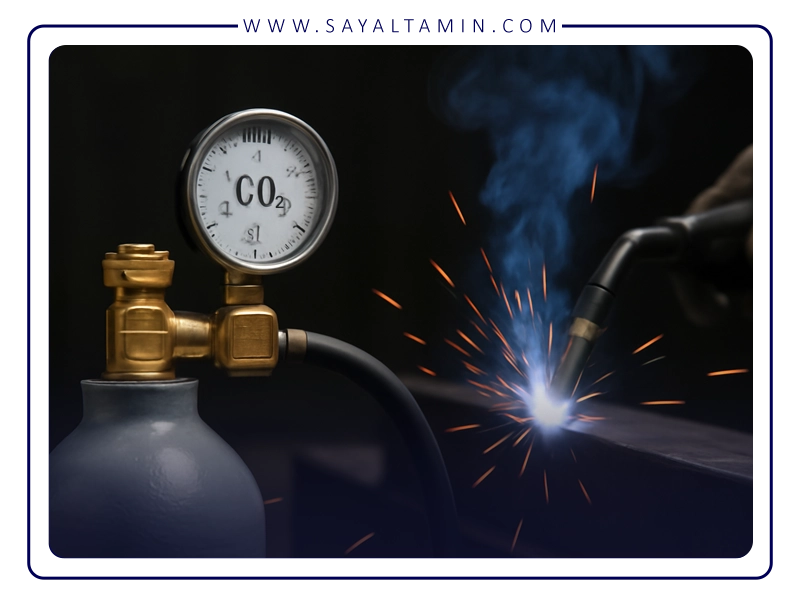
Advantages of using pure CO₂:
• Cost-effectiveness and ease of access: One of the main reasons for the popularity of CO₂ is its lower cost compared to argon or gas mixtures. This feature makes it suitable for large projects or production shops with limited budgets.
• Deeper weld penetration: CO₂ makes the welding arc hotter and more stable, which results in better penetration into the base metal. This feature is especially important when welding thick parts.
• Ability to use higher voltage and amperage: CO₂ gas allows for adjustment of welding parameters over a wider range, which provides greater flexibility in performing different welds.
Disadvantages and limitations:
• Excessive spatter: One of the main challenges of CO₂ welding is the generation of excessive spatter, which requires post-weld cleaning and increases time and cost.
• Weld appearance quality: The weld produced usually has a rougher, wavy appearance, which may be undesirable in industries sensitive to weld aesthetics (such as automotive).
• Limitations on use with non-ferrous metals and stainless steels: CO₂ can cause oxidation and problems such as porosity and reduced corrosion resistance in these metals.
• Smoke production and need for proper ventilation: CO₂ welding produces more smoke due to active reactions, which requires compliance with safety precautions and industrial ventilation.
| Read more: The importance of carbon dioxide in industrial processes |  |
Argon-carbon mixture (Ar-CO₂)
Argon and carbon dioxide mixtures are combinations of neutral and active gases that have been developed with the aim of optimizing the welding process. Different percentages of CO₂ and argon provide specific conditions for each type of welding, which are used in industry as standard (for example, 75% argon – 25% CO₂ or 90% argon – 10% CO₂).
Advantages of Ar-CO₂ mixtures:
• Significant reduction in spatter: The presence of argon in the mixture makes the arc more stable and reduces the ejection of molten particles, which reduces the cost and time of post-welding cleaning.
• More stable and controllable welding arc: Argon is an inert gas that gives the welding arc more strength and focus, allowing even less experienced welders to produce higher quality welds.
• Better weld appearance: Welds created with these mixtures are typically smoother, more uniform, and more aesthetically pleasing, which is of particular importance in the automotive, medical device, and display industries.
• Wider compatibility with different metals: By adjusting the CO₂ percentage, these mixtures can be suitable for welding carbon steels, low alloy steels and especially stainless steels. In stainless steel, a low CO₂ percentage is essential to maintain anti-corrosion properties.
• Reduced smoke production and improved working conditions: Ar-CO₂ mixtures produce less smoke than pure CO₂, which increases workplace safety.
Disadvantages of Ar-CO₂ mixtures:
• Higher cost: Argon gas is more expensive than CO₂, and as a result, argon-carbon mixtures have a higher cost that must be considered in the economic calculations of projects.
• Lower penetration than pure CO₂: At the same voltage and amperage, the weld penetration in Ar-CO₂ mixtures is usually lower than pure CO₂, which requires careful adjustment of welding parameters.
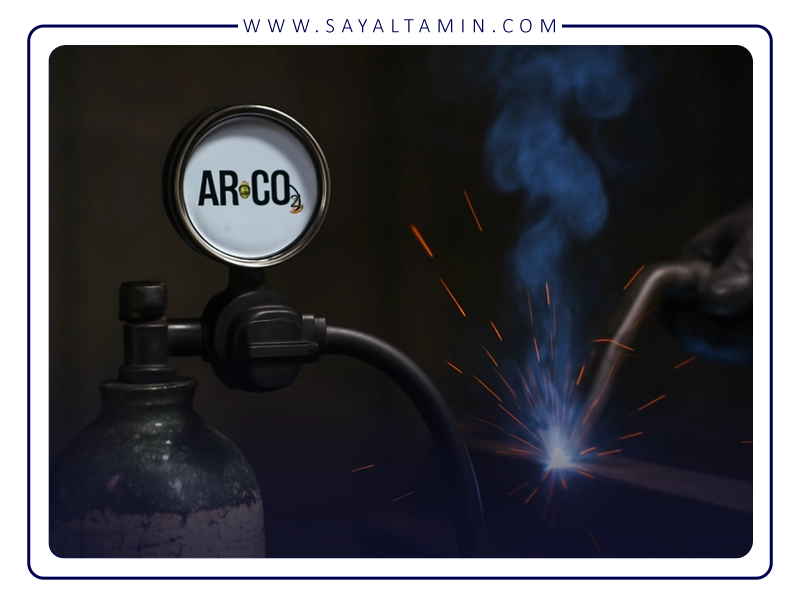
Key points in choosing shielding gas for welding
The correct choice of shielding gas depends on several factors, including:
• Base metal type and thickness: For thicker carbon steels, pure CO₂ is a good choice. For more sensitive alloys and stainless steels, an Ar-CO₂ mixture is a better choice.
• Appearance quality required: If weld appearance is important, an argon-carbon mixture is recommended.
• Project budget and cost: Pure CO₂ is more economical, but the costs of cleaning and lower quality must be considered.
• Welder experience and skill: The more stable arc of mixtures makes welding easier for less experienced welders.
• Safety and work environment conditions: Mixtures produce less smoke and are better suited for enclosed or poorly ventilated work environments.
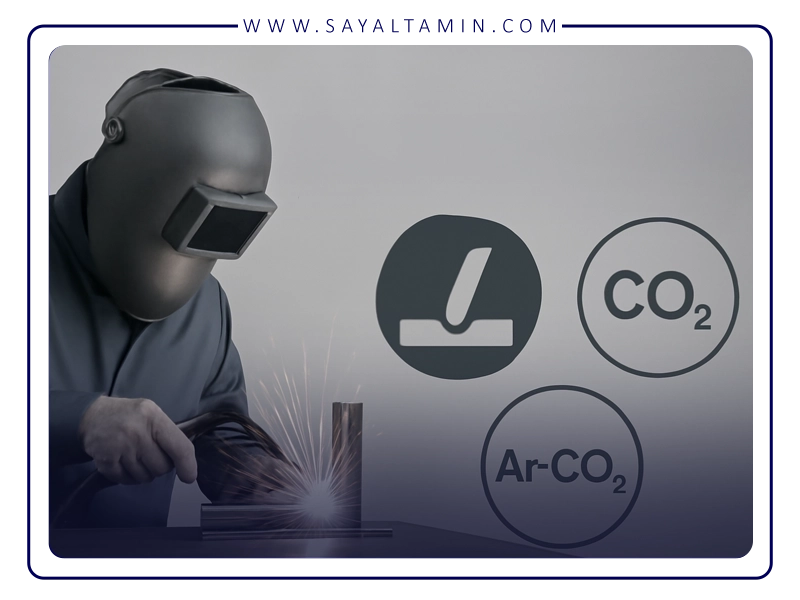
| Be sure to read: Liquid argon for filling light bulb bulbs |  |
Industrial and commercial applications
In various industries, depending on technical, economic and quality requirements, the choice of shielding gas has a direct impact on the production process and productivity:
• Automotive industries: Due to high sensitivity to the appearance and quality of the weld, argon-carbon mixtures are more commonly used.
• Oil, gas and petrochemical industries: For welding thick, high-strength steel structures, pure CO₂ is usually preferred due to its deep penetration and lower cost.
• Small and medium-sized workshops: Given the limited budget, pure CO₂ is more applicable as an economical and efficient option.
• Medical and electronic equipment manufacturing: Due to the high sensitivity of metals and the need for precise welds, mixtures with a low percentage of CO₂ are used.
Our company’s services in supplying welding gases
With years of experience in supplying and selling gas condensates and industrial gases, our company offers pure carbonic gases with guaranteed quality and competitive prices.
We guarantee:
• Continuous and fast supply: Your needs will be met in any volume and time.
• Strict quality control: All gases are tested and guaranteed in accordance with national and international standards.
• Technical support and expert advice: Our experts are ready to respond and provide optimal solutions for each project.
• Safe transportation: Packaging and shipping are carried out in accordance with safety and environmental standards.
The choice between pure carbon dioxide and an argon-carbon mixture depends on the project conditions and technical needs. By carefully understanding the advantages and limitations of each gas, you can make an intelligent decision that will reduce costs and improve welding quality. Our company is always ready to provide expert advice on choosing the best shielding gas for your needs.
————————————————–
References
1.www.esab.com
2. www.eurekaoxygencompany.com
3. www.sciencedirect.com