

This post is also available in: Persian Armenian
Liquid carbon dioxide (CO₂) is a versatile and valuable material in modern industries, having attracted significant attention over the past few decades from the food, oil and gas, chemical, and pharmaceutical sectors. Due to its unique physical and chemical properties, ease of storage and transport, and diverse applications, CO₂ has become a vital tool for enhancing efficiency and reducing operational costs.
Modern industries face multiple challenges: decreasing energy resources, regulatory pressure for environmental compliance, the need to optimize production processes, and demands for higher product quality. In this context, the use of liquid CO₂ as a processing agent, green solvent, cooling medium, and process gas can serve as a key economic and technological solution.
Physical and Chemical Properties of Liquid CO₂
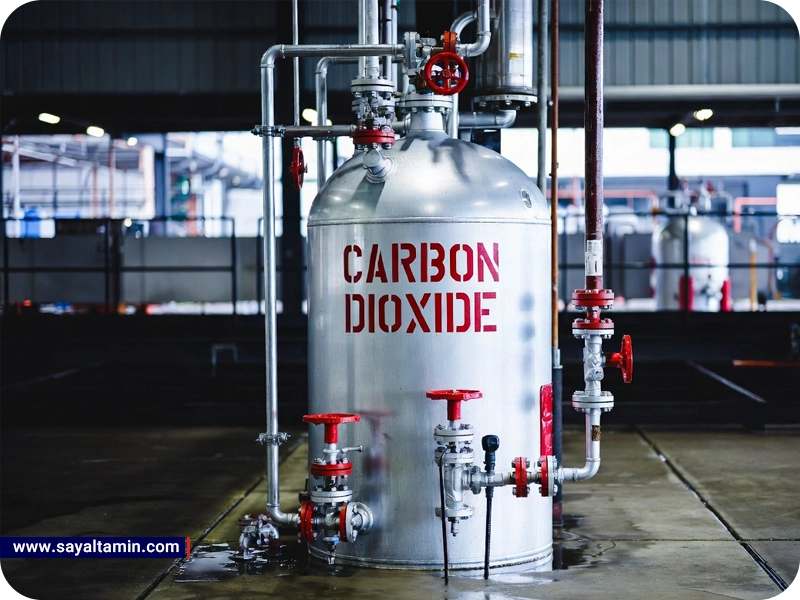
Liquid CO₂ remains stable under specific pressure and temperature conditions. It exists in liquid form below 31.1°C and at pressures above 73.8 bar. These characteristics enable safe and efficient storage and transport in industrial tanks and pipelines.
Key Properties:
- High Density: Liquid CO₂ has a density ranging from 0.77 to 1.0 g/cm³, reducing required storage volume and making transportation more economical. In oil and gas industries, this allows large amounts of CO₂ to be transported without expanding storage capacity.
- High Solubility in Liquids and Oils: Liquid CO₂ can dissolve various compounds and enhance chemical reaction efficiency. This property is critical in chemical and pharmaceutical industries for extracting plant oils, synthesizing specialty drugs, and producing bioactive compounds.
- Cooling Capability: When liquid CO₂ is released to ambient pressure, it rapidly evaporates, absorbing heat from its surroundings. This property is useful for rapid food freezing, industrial equipment cooling, and fire suppression systems.
- Safety and Non-Flammability: Liquid CO₂ is odorless and non-flammable, reducing the risk of fire and preventing unwanted changes in product quality.
These properties make liquid CO₂ not only an efficient and safe processing medium but also an economical alternative to many traditional solvents and process gases.
Economic Analysis of Liquid CO₂ Usage
Using liquid CO₂ in modern industries provides not only physical and process benefits but also substantial economic advantages by reducing costs, increasing production efficiency, and improving return on investment (ROI). The economic analysis can be broken down into three main areas: cost reduction, production efficiency, and ROI.
Cost Reduction
Liquid CO₂ can directly and indirectly reduce operational costs across multiple industries:
- Reduced Raw Material Costs:
Traditional industrial processes often rely on expensive, energy-intensive chemical solvents. For example, extracting bioactive compounds or producing specialty pharmaceuticals typically requires solvents like ethanol, methanol, or acetone, which not only have high purchase costs but also entail safety management and waste disposal expenses.
Using liquid CO₂ as a solvent substitute significantly lowers raw material costs. Additionally, CO₂ can be recycled and reinjected into the process, reducing recurring expenses and making production cycles more economical. - Energy Savings:
Due to its thermodynamic properties, liquid CO₂ can act as a cooling and process medium. In the food industry, rapid freezing with CO₂ reduces reliance on traditional energy-intensive refrigeration systems. In chemical processes, CO₂ facilitates heat transfer during reactions and extractions, optimizing heating and cooling energy requirements. - Reduced Waste and Product Loss:
Extending product shelf life and maintaining quality is another economic advantage. In the food industry, using CO₂ in packaging and storage delays spoilage, reducing production, storage, and distribution losses. In oil and gas operations, enhanced oil recovery and minimized product loss directly increase financial returns.
Overall, cost reductions through material replacement, energy savings, and waste reduction can lower operational costs by 20–30%, generating significant annual savings.
Increased Production Efficiency
One of the most notable benefits of liquid CO₂ is its ability to increase production efficiency across industries:
- Enhanced Oil Recovery (EOR):
Injection of liquid CO₂ increases reservoir pressure and reduces oil viscosity, enabling higher oil recovery rates. Studies indicate that oil recovery can increase by 15–20%, directly boosting annual revenue. - Food and Beverage Industry:
Liquid CO₂ extends shelf life and preserves product quality, increasing sales and reducing losses from spoilage. For instance, CO₂-assisted packaging of frozen meat or protein products can double or triple product longevity, reducing production costs and increasing operational profit. - Chemical and Pharmaceutical Industry:
As a green solvent, CO₂ improves extraction efficiency and accelerates reactions. This not only reduces material usage but also shortens production time, allowing higher output with the same facility capacity.
In general, productivity gains through liquid CO₂ usage significantly enhance profitability and global competitiveness.
Return on Investment (ROI)
Investment in liquid CO₂ infrastructure includes high-pressure tanks, corrosion-resistant pipelines, temperature and pressure control systems, and CO₂ recovery and reinjection equipment. While initial costs may be substantial, economic analysis shows a short and justifiable ROI period:
- In oil and gas, a 15–20% increase in oil recovery can yield ROI on CO₂ injection equipment within 1–2 years.
- In food industries, reduced waste and extended product life can recover CO₂ equipment costs within 12–18 months.
- In chemical industries, process optimization and reduced expensive solvent consumption accelerate ROI.
Annual ROI for liquid CO₂ usage is often reported between 25–35%, demonstrating significant economic justification across industries.
Sample Economic Analysis Table
| Economic Indicator | Traditional Process | Using Liquid CO₂ | Detailed Explanation |
|---|---|---|---|
| Raw Material Cost | $100,000 | $75,000 | Reduced chemical solvent usage, CO₂ recycling, less material waste |
| Energy Cost | $50,000 | $35,000 | Lower demand for heating/cooling, CO₂ as process medium |
| Production Increase | – | 20% | Higher oil recovery in EOR, increased saleable product in food & chemicals |
| Waste Reduction | – | 15% | Reduced spoilage, minimized process losses |
| Annual ROI | – | 30% | Faster investment payback through savings and production gains |
This table illustrates that the economic impact of liquid CO₂ extends beyond cost reduction to include production gains, waste reduction, and rapid ROI, collectively generating substantial added value.
Challenges and Limitations
Despite its advantages, liquid CO₂ use presents operational and economic challenges:
- Initial Investment Costs:
CO₂ storage requires controlled pressure and temperature conditions. High-pressure tanks, corrosion-resistant pipelines, and safety systems represent significant upfront costs, which are offset over time by material and energy savings. - Safety and Staff Training:
CO₂ leaks can cause asphyxiation or frostbite. Personnel must receive comprehensive safety training, use appropriate protective equipment, and rely on installed monitoring and ventilation systems to prevent accidents and financial loss. - Environmental and Regulatory Compliance:
Industrial CO₂ use is closely monitored by environmental authorities. Compliance with standards, permits, and reporting increases costs and effort but mitigates legal risk and ensures social acceptance.
Investment Outlook and Opportunities
With the rise of green industries and global pressure to reduce greenhouse gas emissions, liquid CO₂ represents an attractive economic opportunity. Investments in CO₂ technologies offer:
- Reduced operational and energy costs
- Increased production efficiency and minimized waste
- Access to new green, environmentally friendly product markets
- Strengthened global market competitiveness
Emerging technologies such as carbon-capturing concrete (CarbonCure), biodegradable plastics, and green chemical products provide substantial economic opportunities. Early adopters of these technologies gain long-term competitive advantages.
Liquid CO₂, with its unique physical and chemical properties, is a versatile process medium and powerful economic tool in the food, oil and gas, chemical, and pharmaceutical industries. Comprehensive economic analyses show that using liquid CO₂ reduces costs, improves production efficiency, minimizes waste, and delivers rapid ROI.
When combined with safety protocols, staff training, and environmental compliance, liquid CO₂ provides a sustainable and economically viable solution for industrial process improvement and profitability. Smart investment in this field can yield long-term competitive advantages and broad economic opportunities.
————————————————–
resource
1. IPCC. (2021). Carbon Dioxide Capture and Storage. Intergovernmental Panel on Climate Change.
2. Korre, A., Durucan, S. (2015). Enhanced Oil Recovery Using CO₂: An Economic Assessment. Energy Economics, 50, 1–11.
3. Alvarado, V., Manrique, E. (2010). Enhanced Oil Recovery: An Update Review. Energies, 3(9), 1529–1575.