
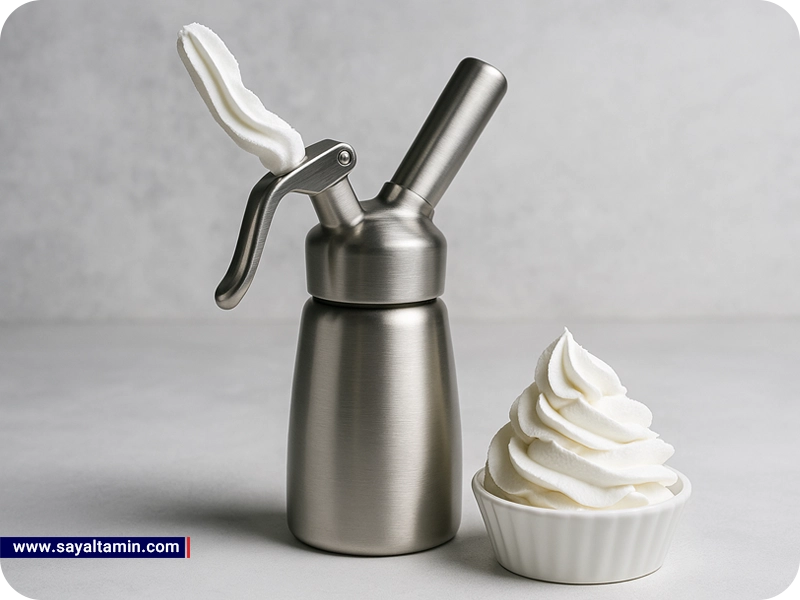

This post is also available in: Persian Armenian
Nitrous oxide (N₂O)—often nicknamed “laughing gas”—is a colorless, non-flammable gas with a faint, slightly sweet odor. While it is widely known for controlled anesthetic and analgesic use in medicine and dentistry, its role in the food industry is extensive and essential.
From whipped cream to ice cream, cooking oil sprays, carbonated-style beverages, and modified-atmosphere packaging, N₂O helps manufacturers deliver consistent texture, stability, and shelf life.
This article explains how N₂O works in food applications, the specific advantages for whipped cream, broader uses across categories, and the key quality and safety controls required for compliant, consumer-safe products.
What Is Nitrous Oxide (N₂O)?
N₂O consists of two nitrogen atoms and one oxygen atom. At ambient temperature and pressure it is a colorless gas, and at relatively low temperatures under pressure it liquefies, which is why it is commonly supplied in pressurized cartridges/cylinders for food processing equipment.
Key properties relevant to food use:
Non-flammable; at elevated temperatures it can act as an oxidizing agent.
Higher density than air and high solubility in fats/oils, which is critical to its behavior in dairy applications.
Supplied as food-grade gas (high purity, controlled contaminants) for direct contact with foods.
Safety note: At low, controlled concentrations N₂O is safe for its intended food uses. Prolonged or uncontrolled inhalation can displace oxygen and cause adverse health effects (e.g., dizziness, headache, hypoxia). Always follow applicable food and occupational-safety regulations.
| Read more: Use of nitrous oxide in cars |  |
How N₂O Creates Whipped Cream: Mechanism of Action
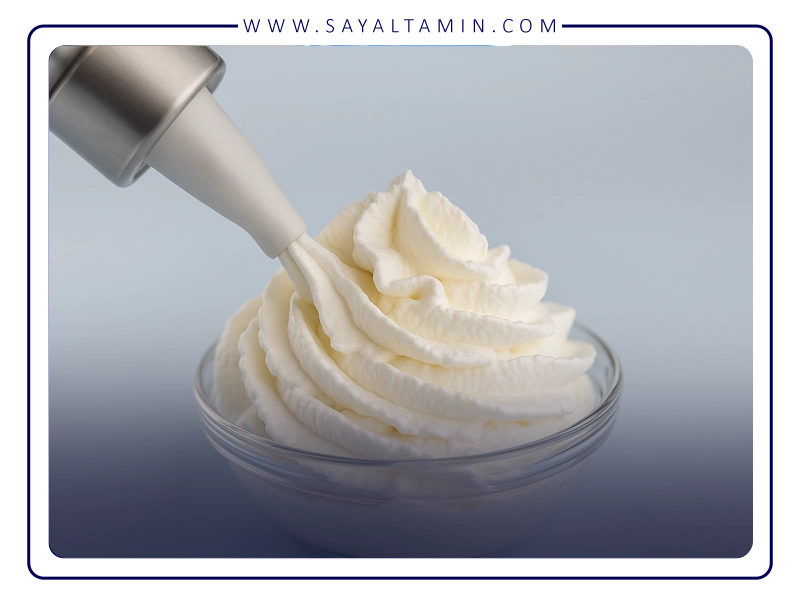
Whipped cream’s signature light, airy, stable foam
is largely due to how N₂O behaves in high-fat emulsions:
Rapid dissolution in fat:
Because N₂O is fat-soluble, it dissolves efficiently in the cream while under pressure inside the canister, distributing uniformly throughout the emulsion.
Lowering interfacial tension:
Dissolved N₂O reduces surface/interfacial tension between the fat and aqueous phases, making bubble formation easier and reducing bubble coalescence.
Bubble nucleation on dispensing:
When the valve is opened, pressure drops and N₂O comes out of solution, forming fine gas bubbles throughout the cream that expand the matrix and create volume.
Protein-fat stabilization:
Dairy proteins—especially caseins—and partially crystallized fat globules stabilize bubble walls, limiting gas escape and helping the foam keep its light, voluminous structure.
Benefits of Using N₂O in Whipped Cream
Light, uniform texture & higher overrun:
Fine, stable bubbles produce a lighter mouthfeel, increased volume, and consistent appearance.
Improved shelf life and handling:
Foam stability supports better stand-up performance, transport, and storage—within normal chilled distribution.
Operational simplicity & speed:
Standard whipper systems and chargers are easy to use, cost-effective, and don’t require complex equipment.
Flavor experience:
Although N₂O is essentially odorless and tasteless, its solubility in fat can help disperse flavors/aromas more uniformly across the foam.
Ancillary microbial control (limited):
In some formulations, N₂O may contribute to conditions that discourage certain microbial growth, but it is not a sterilant and should never replace validated hygienic design, pasteurization, cold chain, and preservative strategies where required.
Critical Quality & Safety Considerations
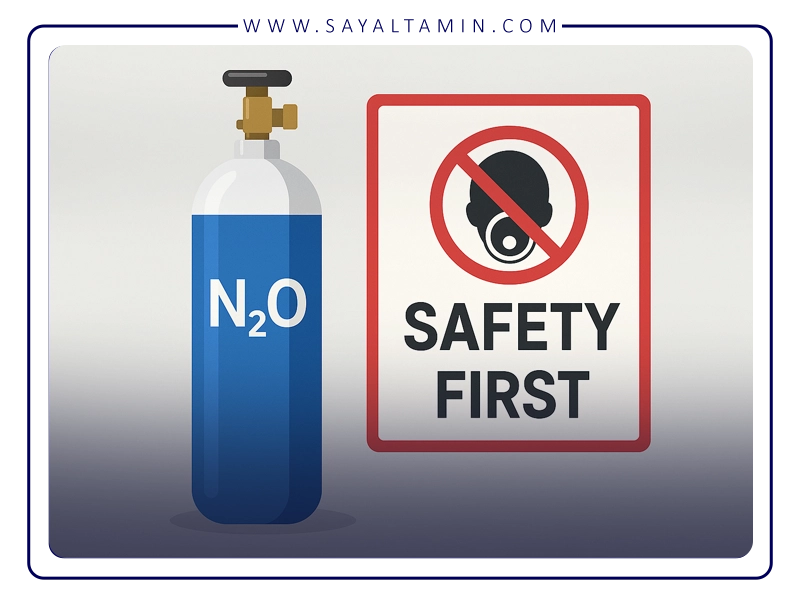
Use only food-grade N₂O:
Gas must meet food-grade specifications (purity and contaminant limits). Industrial-grade gas is not acceptable for food contact.
Control the delivered gas level:
Charge volumes/pressures must align with equipment specs and recipe. Over-charging can harm texture and raise safety risks.
Hygiene and cold chain:
Maintain CIP/SIP or equivalent sanitation, use pasteurized cream, and keep products refrigerated per formulation and local regulations.
Storage and handling of cylinders:
Keep cartridges/cylinders upright, cool, dry, and away from heat sources; secure them to prevent falls/impact. Follow manufacturer instructions.
Staff training:
Train operators on correct charging, dispensing, leak checks, PPE as required, and safe gas handling to avoid oxygen displacement in poorly ventilated spaces.
Labeling & consumer information:
Where applicable, ensure clear labeling and instructions for storage and use. Comply with local food-label, propellant, and packaging rules.
Beyond Whipped Cream: Broader Food Applications

Ice cream & frozen desserts
Texture & ice crystal management: Fine bubbles and process conditions can help limit large crystal formation, yielding a smoother product.
Volume & stability: Can assist with overrun and meltdown characteristics when used appropriately.
Cooking oil sprays
Safe, efficient propellant: N₂O is non-reactive with edible oils in normal use and supports even spray patterns, improving portion control.
Beverages (specialty foams & nitro-style drinks)
Adds fine, creamy bubbles to coffee beverages, dessert drinks, and certain cocktails for a silky mouthfeel distinct from CO₂.
Modified-atmosphere packaging (MAP)
In some applications N₂O can function in protective atmospheres to help preserve sensory quality. Always validate gas mixes per product and regulatory standards.
Cheese and dairy preparations
Can contribute to open/porous structures in certain styles where a light, aerated matrix is desired (process-dependent).
Sauces and condiments
Enables aerated, whipped textures in dressings and culinary foams, enhancing perceived flavor release and plate appeal.
| Must read: Use of nitrous oxide in medicine and dentistry |  |
Used correctly and in food-grade quality, nitrous oxide is a versatile processing aid that enhances texture, stability, and user experience across multiple categories—most notably whipped cream.
Success depends on controlled dosing, rigorous hygiene and cold-chain management, appropriate equipment, and regulatory compliance. With sound process design and operator training, N₂O helps producers deliver lighter, more stable, and longer-lasting products that consumers love.
(Optional) Executive Summary for your blog card
What it is: Food-grade N₂O, a non-flammable propellant with high fat solubility.
Why it matters: Creates fine, stable bubbles → light, voluminous whipped cream and improved texture in desserts, foams, and sprays.
Safety essentials: Food-grade only, control charge levels, sanitize equipment, cold chain, proper storage, trained staff, compliant labels.
Where else used: Ice cream, oil sprays, specialty beverages, MAP, sauces/foams.
————————————————–
References