
This post is also available in: Persian Armenian
What is dark matter?
Evidence for the existence of dark matter
There is numerous pieces of evidence for the presence of dark matter, including:
• Rotation of galaxies: The rotation speed of stars at the edges of galaxies is higher than expected. If only visible mass were present, these stars should be separated from the galaxy. The presence of invisible mass could explain this discrepancy.
• Gravitational lensing: Light from distant objects is bent as it passes by galaxy clusters. The amount of bending is greater than the apparent mass of the clusters.
• Large-scale structure of the universe: Cosmological simulations show that without dark matter, current cosmic structures (such as galaxies and clusters) would never have formed.
• Cosmic background radiation (CMB): Temperature patterns recorded since the Big Bang clearly indicate the existence of an invisible component in the energy composition of the universe.
Candidate particles for dark matter
To explain this phenomenon, scientists have hypothesized the existence of new particles that have not yet been observed. Some of the most important candidates are:• WIMPs (weakly interacting massive particles): Their mass is probably a few tens to a few hundred times that of a proton and they rarely collide with ordinary matter.
• Axions: hypothetical light particles that can transform into photons in the presence of strong magnetic fields.
• Sterile heavy neutrinos: Candidates that are detectable only through gravity and have no nuclear or electromagnetic interactions.

Methods for directly searching for dark matter
The basic idea behind directly searching for dark matter is simple but challenging: If a dark matter particle (WIMP) were to pass by Earth and collide with the nucleus of an atom, it would release a tiny amount of energy in the form of light, electric charge, or heat. Detectors would need to be sensitive enough to pick up these faint signals amidst a lot of ambient noise.
Where to set up experiments
Dark matter detectors are installed deep underground to reduce the effects of cosmic rays. These rays can produce thousands of false signals per second, so the test environment must be protected from them. To do this, deep mines, mountain tunnels and even under polar ice caps are used as natural shields. For example, the DarkSide experiment is located at the Gran Sasso laboratory in Italy, 1,400 meters below the mountains.
Materials used in detectors
• Germanium crystals: They have high energy sensitivity and are suitable for detecting very weak signals, but due to their limited volume, they cannot record large-scale dark matter signals.
• Liquid xenon: Due to its high density and efficiency in separating signals, it is the most widely used material in current generation detectors, but the cost of extracting xenon is very high.
• Liquid argon: At a lower cost and easier access, it allows for the construction of very large detectors, and its optical properties are excellent for separating signals from noise.
Physical and chemical properties of liquid argon
Physical Properties
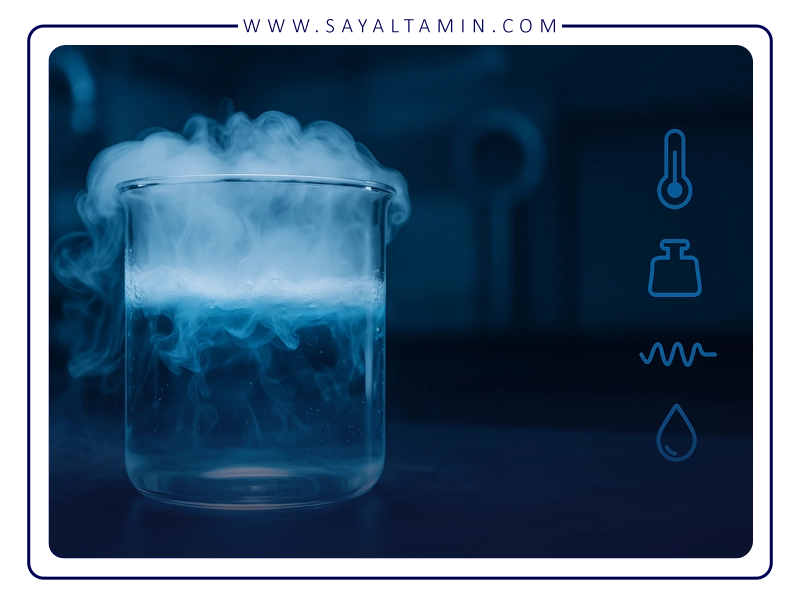
• Boiling point: about -186°C.
• Density: about 1.4 g/cm³ in the liquid state.
• Fluorescence wavelength: 128 nm (in the ultraviolet range), which is recorded by photomultipliers and special sensors.
• High transparency: Photons produced in the collision can travel a long distance inside the argon, which helps to accurately record the signal.
Chemical Properties
• A noble, inert gas that does not react with other substances.
• Non-flammable and safe in industrial and scientific applications.
• Due to its chemical stability, its purity is easily maintained under controlled conditions.
Abundance and Cost
Argon is the third most abundant gas in the Earth’s atmosphere and is much cheaper and more accessible than xenon, which makes up only a very small fraction of the atmosphere. This advantage allows scientific projects to utilize several tons of liquid argon.
Application of liquid argon in neutrino and dark matter detectors
Detection Mechanism
The collision of a dark matter particle with an argon nucleus leads to three phenomena:
1. Ultraviolet light emission (Scintillation): which is recorded quickly and provides information about the type of impact.
2. Ionization: The released electrons move in the electric field and are converted into an electrical signal.
3. Heat: A small fraction of the energy is released as heat, which can be measured in some advanced detectors. The combination of these signals allows for precise discrimination between WIMP collisions and background particles such as neutrinos or radioactive rays.
Notable Projects
• DarkSide (Italy): Using liquid argon to reduce background noise and detect WIMPs. Newer versions of this project use underground argon to reduce radioactive contamination.
• DEAP-3600 (Canada): One of the largest liquid argon detectors in the world, aiming to achieve unprecedented sensitivity.
• ArDM (Switzerland): A pioneering experiment that showed argon could act as an efficient medium in the search for dark matter.
• DUNE (USA): Although its main focus is on studying neutrinos, the technologies developed there will also help in dark matter detectors.
| Must Read: The Vital Role of Pharmaceutical Argon in the Pharmaceutical and Medical Equipment Industry |  |
Technologies related to the use of liquid argon

Purification
The radioactive isotope argon-39 is the biggest challenge in using argon. By extracting argon from underground sources (not from the atmosphere), the amount of this isotope is greatly reduced. Filtration and chemical absorption systems also help to increase purity.
Cooling and storage systems
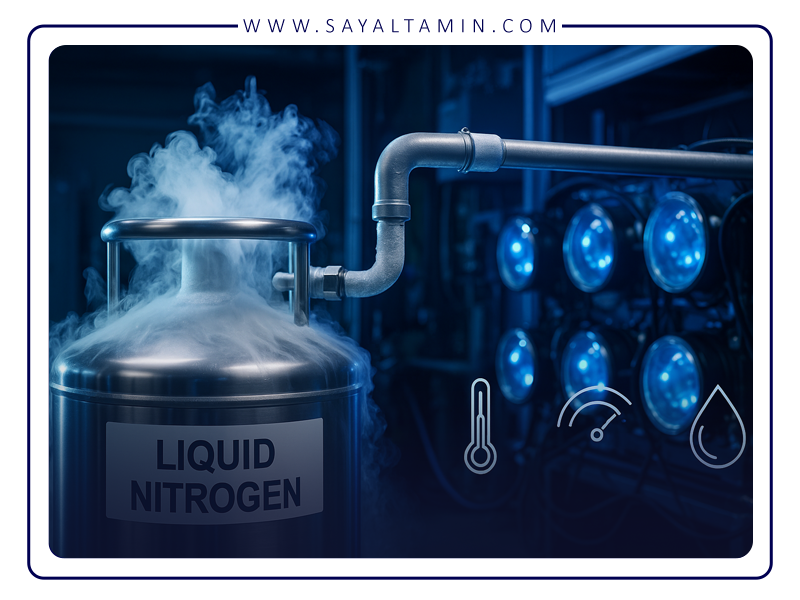
Maintaining liquid argon requires advanced refrigeration systems. These systems must:
• Maintain a stable temperature of around -186 degrees Celsius.
• Prevent leakage or evaporation.
• Be scalable to maintain efficiency in detectors weighing several tens of tons.
Optical and electrical sensors
• Photomultipliers (PMT) are produced to record ultraviolet light.
• Silicon photomultipliers (SiPM) are newer options with high sensitivity.
• Charge sensors: to collect free electrons and convert them into an analyzable signal.
Data processing algorithms
Advanced algorithms and even machine learning are used to analyze the data generated from the detectors to distinguish the real signal from the noise.
Challenges and solutions
Although the use of liquid argon in direct dark matter searches has many advantages, it also faces serious challenges. In this section, each of the main obstacles and the proposed solutions to overcome them are discussed in detail:
Radioactive contamination (Argon-39)
The radioactive isotope Argon-39, which occurs naturally in the Earth’s atmosphere, is a significant source of background radiation in detectors. The half-life of this isotope is about 269 years, and its radioactivity can cause many false signals. To overcome this problem:
• The use of underground argon, which is not exposed to cosmic rays and has a much lower content of Argon-39, has been proposed.
• The development of isotope separation technologies can reduce the amount of radioactive impurities.
High costs of refrigeration systems
Maintaining large quantities of liquid argon requires very precise and expensive cooling systems. These systems must not only maintain temperatures as low as -186 degrees Celsius, but also be stable and safe. The proposed solutions include:
• Using new cryogenic energy storage technologies to reduce energy consumption.
• Designing scalable systems that can handle larger quantities of argon at lower cost.
Scalability of detectors
To achieve sufficient sensitivity in the search for WIMPs, detectors must use tens to hundreds of tons of liquid argon. Such a volume of material requires advanced engineering designs. Solutions:
• Using modular tanks that can be gradually expanded.
• International collaborations to provide the funding and resources needed for large projects.
Data Management
Each collision in the detector produces a large volume of optical and electrical data. Given the large size of these detectors, the data can reach several petabytes per year. To manage this volume:
• Developing real-time processing algorithms to separate signals from noise.
• Using supercomputers and distributed computing networks.
Environmental Noise
Cosmic rays and naturally occurring radioactive sources in rocks and test equipment can create unwanted signals. To combat this:
• Place detectors deep underground or under mountains.
• Use active and passive shielding to reduce background radiation.
The economic and industrial importance of liquid argon
In addition to fundamental research, liquid argon also plays a vital role in various industries:
• Electric arc welding: Argon acts as a shielding gas to prevent metals from oxidizing.
• Medical: Used in cooling treatments such as cryotherapy and delicate surgeries.
• Electronics and semiconductors: Provides an inert environment for the production of sensitive chips and components.
• Metallurgy: Used in the production of steel and special alloys to reduce impurities.
• Scientific research: from dark matter detectors to accelerators and neutrino experiments.
The global market for liquid argon is growing, and demand for the material is expected to increase over the next decade as scientific and industrial projects increase, making it a strategic commodity in the energy and science sectors.

| Read more: Liquid Argon in Nuclear Reactors | 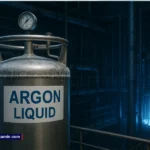 |
The future of dark matter research with liquid argon
Future projects are being planned that will use tens or even hundreds of tons of liquid argon. For example:
• DarkSide-20k: a next-generation detector with 20 tons of argon.
• Joint international projects: cooperation between different countries to build huge detectors deep in the Earth.
این پروژهها میتوانند در دههی آینده سرنخهای قطعیتری از ماهیت ماده تاریک ارائه دهند.
Liquid argon has a unique combination of scientific and industrial properties. On the one hand, it is a key material for one of the most important scientific challenges of mankind, namely the discovery of dark matter; on the other hand, its wide applications in welding, medicine and advanced industries have given it a special economic position.
Expanding the use of argon in scientific projects will not only transform our understanding of the universe, but will also help develop new technologies that could impact our daily lives. Advanced cooling systems, gas purification technologies, big data processing algorithms, and sensing equipment are all examples of achievements that were initially developed for dark matter research but later found their way into other sectors of industry and medicine.
On the other hand, the growth of the global liquid argon market will allow various industries to benefit from its economic benefits. This overlap between basic research and industry paints a bright future; a future in which science and technology go hand in hand and simultaneously meet the scientific and economic needs of humanity.
In this way, liquid argon is not only a material for advancing the frontiers of particle physics knowledge, but also a bridge between fundamental science and the practical needs of today’s societies.
————————————————–
Resources:
Aalseth, C. E., et al. (2024). DarkSide-20k sensitivity to light dark matter particles. Communications Physics, 7, 82.
Bell, N., et al. (2020). Migdal effect and photon Bremsstrahlung: improving the sensitivity to light dark matter of liquid argon experiments. arXiv:2006.02453.
Cern Courier. (2019). Defeating the background in the search for dark matter. Retrieved from
www.cerncourier.com