

This post is also available in: Persian Armenian
Cryogenic gases are substances that liquefy at extremely low temperatures, exhibiting physical and chemical properties markedly different from their gaseous state. While these gases have broad applications across various industries, their storage, transport, and use require strict adherence to safety standards. Common hazards include cryogenic liquid leaks, line freezing, and metallic equipment failure, all of which can result in serious accidents or even fatalities.
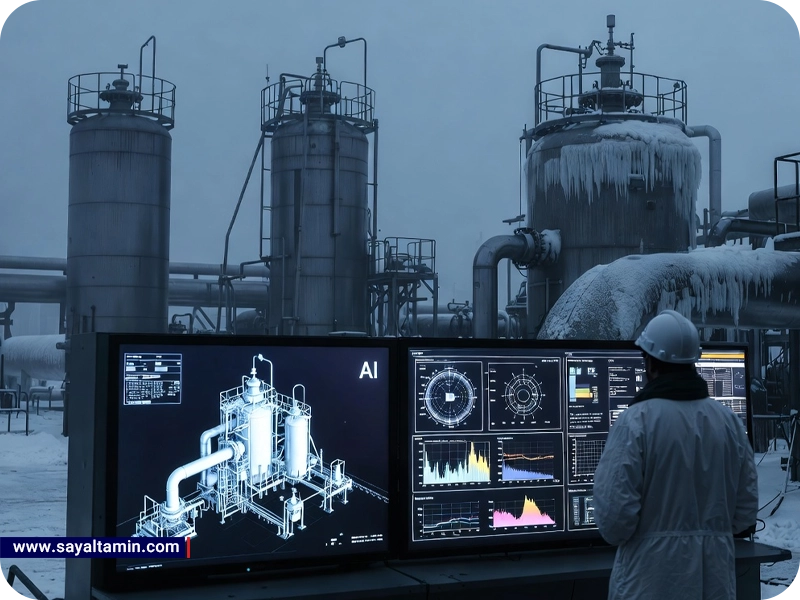
Over the past decade, artificial intelligence (AI) has increasingly entered the industrial gas sector, particularly in safety management. By collecting data from sensors, thermal imaging, and operational trend analysis, AI algorithms can predict which parts of a system are at risk of leaks or equipment failure. These predictive capabilities not only prevent accidents but also reduce costs associated with production downtime and emergency repairs.
Safety Features and Hazards of Cryogenic Gases (Extended Overview)
Cryogenic gases, due to their extremely low temperatures and unique physical behavior, are among the most complex yet widely used materials in advanced industries. Examples include liquid nitrogen (LN₂), liquid oxygen (LO₂), and liquid argon (LAr). Their storage and transport require advanced equipment and strict safety standards.
A major challenge is maintaining material and equipment integrity at cryogenic temperatures. Metals and plastics often undergo brittle hardening, meaning their mechanical resistance decreases and they may crack or fracture under minor stress or impact.
Direct human contact with these gases or their liquid forms can cause cold burns, eye and skin injuries, or even death. Operators must therefore use specialized protective equipment such as insulated gloves, cryogenic-resistant clothing, and face shields.
Another critical hazard is the rapid volumetric expansion when liquid gases vaporize. For instance, one liter of liquid nitrogen can expand to approximately 700 liters of gaseous nitrogen. Such sudden expansion in confined spaces can sharply increase internal system pressure, potentially causing explosions or oxygen depletion, leading to asphyxiation.
Oxidizing cryogenic gases like liquid oxygen react violently with combustible materials; even minimal contact with oils or greases can result in fire or explosion. Therefore, the design of transport lines for these gases requires precise control of temperature, pressure, and flow, alongside rapid-response alarm systems.
Mechanisms of Freezing and Equipment Failure
Freezing and equipment failure in cryogenic systems are typically caused by a combination of physical and mechanical factors. A key factor is the extreme temperature differential between the environment and the cryogenic liquid. Metals and pipe connections exposed to ultra-low temperatures lose mechanical strength and become susceptible to brittle fracture, which can occur suddenly even with regular maintenance.
Freezing commonly occurs at joints, control valves, narrow pipe segments, and areas where moisture accumulates. Vapor or environmental moisture can quickly freeze, blocking liquid flow, increasing internal pressure, altering flow directions, and ultimately causing mechanical damage.
Repeated thermal cycling is another major contributor to material fatigue. Cryogenic equipment that regularly oscillates between ambient and ultra-low temperatures develops microcracks that propagate over time, eventually leading to catastrophic failure. Corrosion from moisture or chemical exposure further weakens metals and accelerates failure.
Interactions between pressure, temperature, and gas flow are also critical. Sudden changes, particularly in long or complex systems, can create unexpected thermal and mechanical stresses, endangering equipment integrity.
Traditional physical monitoring and periodic inspections alone are insufficient to accurately predict these critical points. This is where AI comes into play, analyzing data trends and equipment behavior to reduce the likelihood of accidents.
Role of Artificial Intelligence in Predicting Leaks, Freezing, and Equipment Failure
As advanced industrial systems grow more complex, the hazards of cryogenic gas leaks, freezing, and equipment failure have become increasingly critical. Traditional safety monitoring methods, such as routine inspections and manual checks, often cannot detect sudden or nonlinear system behaviors. AI offers a sophisticated solution for accurate hazard prediction and proactive risk management.
AI algorithms utilize real-time data from sensors, pressure and temperature monitors, flow meters, thermal cameras, and SCADA systems to create precise models of equipment performance. These models can identify points prone to leaks, freezing, or material failure even before operators detect any physical signs. Minor variations in temperature or pressure, imperceptible to humans, can be recognized by AI algorithms, triggering early warnings.
A major advantage of AI is its continuous learning from historical and operational data, which improves prediction accuracy over time and identifies rare or unusual equipment behaviors. AI can alert operators to vulnerable sections of pipelines or tanks at risk of freezing or cracking, or even detect abnormal gas flow or internal pressure before an incident occurs.
AI also supports predictive maintenance, where equipment is serviced or replaced only when data indicate a genuine risk of failure, rather than according to a fixed schedule. This reduces maintenance costs, prevents unexpected production stops, and enhances overall system safety.
Main Hazards, Mechanisms, and AI Roles in Prevention and Prediction
| Hazard / Issue | Mechanism | Role of AI in Prevention and Prediction | Operational Example |
|---|---|---|---|
| Cryogenic gas leak | Microcracks, metal corrosion, unbalanced pressure | Analyze pressure and flow data, detect small leaks, alert operators before escalation | Detect microcrack in liquid nitrogen pipe before expansion; automatically stop flow |
| Freezing of lines and valves | Moisture accumulation, low temperature, flow blockage | Monitor temperature and humidity, predict freeze-prone points, recommend flow adjustments or line heating | Alert operator to heat liquid oxygen valves in low ambient temperatures |
| Brittle metal failure | Thermal and mechanical stress, material fatigue, pressure cycling | Model material behavior at low temperatures, predict failure probability, plan preventive maintenance | Predict crack in liquid argon tank before catastrophic failure |
| Explosion or fire | Rapid gas expansion, contact with flammable materials | Detect pressure and temperature patterns leading to explosion risk, provide automatic alerts and flow control | Automatic shutdown of oxygen flow and activation of fire suppression in sudden pressure change |
| Oxygen depletion (asphyxiation hazard) | Rapid liquid evaporation and gas release | Environmental monitoring, predict oxygen drop, trigger automatic alert and ventilation | Warn personnel and activate ventilation in liquid nitrogen storage rooms |
This table illustrates that AI provides a comprehensive, multi-layered approach to cryogenic gas safety. It can not only detect physical and chemical hazards but also suggest preventive operational actions and trigger automated safety processes.
Additional Benefits of AI in Cryogenic Gas Safety
- Predicting incident timing: Algorithms can estimate the likelihood of failure or leaks within a specific time window using historical data.
- Reducing operational costs: Maintenance is performed based on real-time data rather than pre-scheduled intervals, cutting unnecessary expenses.
- Enhancing personnel safety: Preventive alerts and automatic equipment control reduce direct exposure to cryogenic gases.
- Long-term equipment behavior analysis: AI identifies gradual material degradation or destructive trends that traditional methods often miss.
Advantages, Challenges, and Future Outlook of AI in Cryogenic Gas Safety
The benefits of AI extend beyond simple leak or failure prediction. By integrating real-time, historical, and environmental data, AI significantly enhances overall system safety. Key advantages include:
- Higher predictive accuracy: Machine learning algorithms model nonlinear and complex equipment behaviors, pinpointing critical system points with high precision, reducing unexpected accidents.
- Continuous, real-time monitoring: AI systems monitor pressure, temperature, flow, and environment 24/7, enabling rapid response to sudden operational changes.
- Optimized maintenance and cost reduction: Predictive AI maintenance limits repairs and replacements to when truly necessary, lowering operational costs and extending equipment life.
- Personnel and environmental protection: Preventive alerts and automated controls reduce human exposure and limit accidental gas releases.
Challenges remain:
- Data quality and quantity: Accurate AI predictions require comprehensive, high-quality datasets, which may be lacking in older facilities.
- Algorithm complexity: Advanced models need powerful hardware and technical expertise, increasing training costs and time.
- Human–machine collaboration: Final decisions often require human judgment; operators must trust AI outputs and be trained to act on them.
- Data and system security: Sensor, network, and AI system communications may be vulnerable to cyberattacks, threatening operational safety.
Despite these challenges, the future of AI in cryogenic gas safety is promising. Emerging technologies such as deep learning, predictive material behavior analysis, and the Industrial Internet of Things (IIoT) elevate hazard detection and prediction beyond human capabilities. Intelligent systems are expected to not only anticipate risks but also automatically implement preventive actions—adjusting flow, controlling temperature, and issuing instant alerts—without human intervention.
Summary of AI Benefits in Cryogenic Gas Safety
- Increased predictive accuracy and reduced accidents
- Continuous real-time operational monitoring
- Optimized maintenance and cost reduction
- Enhanced protection for personnel and environment
By combining AI with IIoT, predictive material analysis, and automated control systems, the cryogenic industry can achieve transformative improvements in safety, operational continuity, and cost efficiency. Intelligent AI utilization reduces incidents, safeguards employees and equipment, and strengthens sustainable operational management, establishing AI as an indispensable tool in next-generation industrial gas safety systems.
————————————————–
resource
Rao, S., & Sharma, P. (2021). Cryogenic Safety in Industrial Gas Handling: Challenges and AI-based Solutions. Journal of Industrial Safety, 45(3), 211-229.
Li, H., et al. (2020). Artificial Intelligence for Predictive Maintenance in Cryogenic Systems. Applied Thermal Engineering, 180, 115832.
Kim, J., & Park, S. (2019). Advanced Monitoring and Fault Detection in Cryogenic Gas Systems Using Machine Learning. Cryogenics, 100, 12-25.
ASTM International. (2018). Standard Guide for Safe Handling of Cryogenic Liquids (ASTM C1551-18).