

This post is also available in: Persian Armenian
Nitrogen, a colorless, odorless, and nonflammable element with the chemical symbol N and atomic number 7, plays a vital role in the structure of life on Earth. It exists in the Earth’s atmosphere as the molecule N₂ and makes up about 78 percent of the atmosphere’s volume. But nitrogen is also present in other parts of the solar system, even in the Sun. In this article, we will examine the presence and role of nitrogen in the Sun and planets.
Nitrogen in the Sun: Secrets of a Star
The Sun, the central star of the solar system, is the main source of energy and light for all the planets. The composition of the Sun consists mainly of hydrogen (about 74%) and helium (about 24%), with only a very small fraction of it made up of heavier elements such as carbon, oxygen, nitrogen and other metals. Nitrogen is present in a small amount in the Sun compared to the Earth and the planets, but this small amount plays an important role in our understanding of the evolution of stars.
Amount of nitrogen in the sun
Spectroscopic studies using advanced instruments such as the Solar Spectrometer show that nitrogen in the Sun makes up only about 0.1% of its total mass. This is much less than the amount of nitrogen in the Earth’s atmosphere (78%).
This difference is largely due to stellar processes and how the Sun and Solar System formed.
Origin of solar nitrogen
Nitrogen in the Sun is a remnant of the early stages of star formation. The Sun formed about 4.6 billion years ago from a giant cloud of gas and dust called the solar molecular cloud. This cloud consisted of hydrogen, helium, and small amounts of heavier elements that were the product of supernova explosions of ancient stars.
• The nitrogen in the Sun probably originated from the nuclear production of previous generations of stars.
• A supernova explosion releases heavy elements such as nitrogen into space, and these elements play a role in the formation of subsequent generations of stars.
• The Sun also formed by gathering these gases and dust, so the nitrogen in it has a direct effect on cosmic evolution.
The role of nitrogen in solar processes
Despite its small amount, nitrogen plays an important role in the nuclear cycles in the Sun. One such process is the CNO (carbon-nitrogen-oxygen) cycle, which in stars more massive than the Sun replaces the proton-proton cycle for energy production.
• In the CNO cycle, nitrogen acts as a catalyst, converting hydrogen into helium, which releases enormous amounts of energy.
• Although the CNO cycle plays a secondary role in the Sun, it becomes more important in larger, hotter stars.
Sun’s layers and nitrogen dispersion
The Sun is made up of several layers: the core, the radiative zone, the convective zone, the surface (photosphere), and the solar atmosphere. Spectroscopic studies show that nitrogen is very scarce in the outer layers of the Sun, as most of the heavier elements are concentrated in the core and deeper layers.
This important feature allows scientists to use the amount of nitrogen and other elements in the Sun to model the processes of star formation and evolution.
Nitrogen in Solar System and Exoplanets
1. Earth: Home of Nitrogen
Earth is the only planet with a stable atmosphere containing a high percentage of nitrogen (about 78%). This percentage of nitrogen in the Earth’s atmosphere plays a key role in creating stable conditions for life. Nitrogen is one of the main structural elements of DNA and proteins and is therefore essential for life.
Origin of Earth’s Nitrogen
The origin of Earth’s nitrogen is still a controversial topic in the scientific community. There are two main hypotheses:
1. Meteorite and comet impacts: During the early period of the formation of the solar system, the Earth was exposed to violent collisions with celestial bodies, including comets and asteroids. These bodies could have introduced significant amounts of nitrogen gas into the Earth’s atmosphere. Chemical data show that the isotopic composition of nitrogen in the Earth’s atmosphere has similarities to the compositions found in meteorites.
2. Internal processes of the Earth: Nitrogen may also be released from internal sources of the Earth. This process occurs through volcanic activity, which transports gases from the Earth’s interior to the surface. Geological analyses show that a large amount of nitrogen is stored in the deep layers of the Earth, which have been released over millions of years.
| Be sure to read: Use of nitrogen gas in aerospace |  |
The role of nitrogen in the Earth’s atmosphere
Nitrogen is inert on its own, but its role as a “carrier gas” is crucial in maintaining the stability of Earth’s atmosphere. It provides the atmospheric pressure necessary for life and prevents water from evaporating too quickly. Nitrogen is also directly involved in Earth’s biological cycles, particularly the nitrogen cycle, which involves the conversion of atmospheric nitrogen into compounds that plants can use and then returning it to the atmosphere.
۲. Venus: Neighboring planet with a thick atmosphere
The atmosphere of Venus is very different from Earth in terms of composition. About 96% of Venus’ atmosphere is made up of carbon dioxide and only about 3.5% is nitrogen. Despite this small amount, nitrogen plays an important role in the dynamics of the planet’s atmosphere.
Origin of nitrogen on Venus
Research has shown that Venus’ nitrogen likely came from primordial compounds that were present in the protoplanetary disk when the planet formed. Also, complex chemical reactions in the planet’s atmosphere produce nitrogen from other compounds.
The effect of nitrogen on the atmosphere of Venus
The presence of nitrogen in the atmosphere of Venus helps stabilize the planet’s atmosphere. This gas plays an important role in creating the high pressure and extremely high temperature of Venus. The atmospheric pressure of Venus is more than 90 times that of Earth, and these conditions create very complex chemical phenomena in the planet’s atmosphere.
۳. Mars: Secrets of Red Nitrogen
The Martian atmosphere is about 95% carbon dioxide and only about 2.6% nitrogen. This amount of nitrogen is not enough to support sustainable life, but its presence is of scientific importance.
Origin of Nitrogen on Mars
The origin of Martian nitrogen is still under investigation. The main hypotheses are:
• Release from internal sources of Mars throughout its geological history.
• Meteorite impacts that introduced nitrogen gas into the Martian atmosphere.
Research by Mars rovers such as the Mars Science Laboratory has shown that nitrogen compounds on Mars contain heavier isotopes than on Earth, indicating a different origin for these gases.
The importance of Martian nitrogen
The presence of nitrogen in the Martian atmosphere, although small, is important for future human missions. Nitrogen could be used in fuel production, creating artificial atmospheres for habitation, and even in biological processes.
4. Jupiter and Saturn: Gas giants with ammonia nitrogen
The atmospheres of Jupiter and Saturn consist mostly of hydrogen and helium, but they also contain nitrogen in the form of ammonia (NH₃).
The origin of nitrogen on these planets
• Nitrogen compounds were supplied from the protoplanetary disk during the early stages of the formation of these planets.
• Chemical reactions deep in the atmospheres of these planets have converted nitrogen into ammonia.
The role of nitrogen in Jupiter and Saturn
The presence of nitrogen in the form of ammonia plays an important role in the chemical structure and atmospheric dynamics of these planets. This compound can help form clouds and massive storm systems.
۵. Uranus and Neptune: Icy worlds with complex nitrogen compounds
The atmospheres of Uranus and Neptune consist of hydrogen, helium, and nitrogen compounds such as ammonia and hydrogen cyanide (HCN).
Origin of nitrogen on these planets
Some scientists believe that nitrogen on these planets originated from meteorite impacts and primary compounds in the protoplanetary disk. Chemical reactions deep in the atmosphere also produced nitrogen compounds.
Importance of nitrogen on Uranus and Neptune
These nitrogen compounds play an important role in the structure of the clouds of these planets and the chemical processes in their atmospheres. Hydrogen cyanide, in particular, could play a role in complex organic chemical processes that are important for the possibility of life.
6. Titan: A Natural Laboratory for Nitrogen
Titan, Saturn’s largest moon, has a thick atmosphere of nitrogen, which makes up about 98% of it. This nitrogen-rich atmosphere contains complex compounds such as methane and ethane.
Origin of Titan’s Nitrogen
Research suggests that Titan’s nitrogen likely originated from primordial ammonia compounds in Saturn’s protoplanetary disk, which over millions of years formed into nitrogen molecules in the atmosphere.
Special features of Titan’s atmosphere
Titan’s atmosphere resembles Earth’s atmosphere billions of years ago, making it a natural model for studying chemical evolution and the possibility of life elsewhere in the solar system.
7. Nitrogen in exoplanets
Recent research using spectroscopy and advanced technologies shows that nitrogen is also present in the atmospheres of some exoplanets. This discovery is of great importance, because the presence of nitrogen can be an indicator of biological conditions or biological prerequisites.
Importance of the discovery of nitrogen in exoplanets
• A sign of the existence of complex chemical cycles.
• The possibility of the existence of conditions similar to those on Earth for life.
• Helping to understand how planets and their atmospheres form.
| Read more: Applications of liquid nitrogen in the food industry |  |
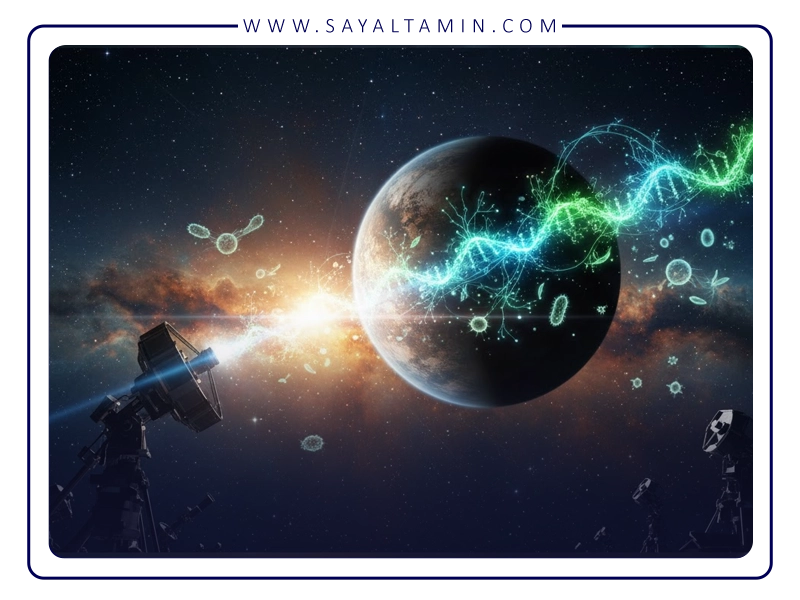
Nitrogen, a key element in the structure of the universe, plays a variety of important roles in the solar system. Its presence in the Sun and various planets indicates its importance in large-scale physical and chemical processes.
On Earth, nitrogen is the most abundant gas in the atmosphere, accounting for about 78% of the atmosphere, providing the basis for stable biological conditions and natural cycles such as the nitrogen cycle. The origin of this element is a combination of internal Earth activity and collisions of celestial bodies during the early stages of planet formation.
On other planets in the solar system, nitrogen exists in different forms and combinations. Venus, with its thick atmosphere of carbon dioxide and low nitrogen content, presents a different set of conditions. Mars, with its thin atmosphere and limited nitrogen content, is an example of the diversity of planetary atmospheric compositions, which presents its own challenges and opportunities for space exploration and human missions. Jupiter, Saturn, Uranus, and Neptune, each with different nitrogen compounds, including ammonia and hydrogen cyanide, reveal a glimpse into the chemical diversity of the solar system.
Titan, Saturn’s largest moon, is a unique example of a nitrogen-rich environment with conditions similar to Earth’s early atmosphere, and could hold the key to understanding how atmospheres form and the possibility of life on other worlds.
The Sun, although made mostly of hydrogen and helium, contains a small amount of nitrogen, which plays an important role in nuclear cycles such as the CNO cycle. This element not only reflects the chemical history of the Solar System, but is also one of the keys to understanding the evolution of stars and their internal physical processes.
Extensive studies and future space missions, including detailed spectroscopic measurements and solar probes, are expected to reveal more of the mysteries of nitrogen in the solar system and beyond.
Ultimately, nitrogen is not just a simple chemical element; it is a fundamental key to understanding the origin of life, the evolution of planets, and the structure of the universe. Future research in this area could open new doors to answering fundamental questions about our place in the universe.
————————————————–
References
1. Amarsi, A. M., et al. (2021). “The solar carbon, nitrogen, and oxygen abundances from a three-dimensional non-local thermodynamic equilibrium model.” Astronomy & Astrophysics, 649, A1.
2. Appel, S., et al. (2022). “Improved measurement of solar neutrinos from the Carbon-Nitrogen-Oxygen fusion cycle.” Physical Review Letters, 129(25), 252701.
3. Caffau, E., et al. (2009). “The solar photospheric nitrogen abundance.” Astronomy & Astrophysics, 508(3), 1687–1692.
4. Geiss, J., et al. (1982). “Nitrogen isotopes in the solar system.” Geochimica et Cosmochimica Acta, 46(5), 1081–1093.
5. Serenelli, A., et al. (2022). “Elemental accounting of the solar interior.” Physics, 15, 190.
6. Yoss, R. (2015). “The Composition of Planetary Atmospheres.” NASA.