
This post is also available in: Persian Armenian
The rapid growth of urban populations, industrial expansion, and rising water consumption have positioned wastewater treatment as one of the most pressing environmental and operational challenges in modern cities. Wastewater treatment plants are essential not only for safeguarding water resources but also as potential sites for energy recovery. Within these facilities, biological treatment processes—particularly sludge digestion—account for a substantial share of energy use, residual waste production, and overall operating costs.
In recent years, advanced technologies aimed at enhancing digestion efficiency and minimizing excess sludge volumes have emerged as a key pillar of sustainable development in the water and wastewater sector. One highly effective approach involves the application of pure oxygen or oxygen-enriched aeration in advanced aerobic digestion processes. This method can simultaneously accelerate the breakdown of organic matter, reduce the volume of final sludge produced, and create more favorable conditions for biogas generation in integrated aerobic–anaerobic treatment systems.
For companies specializing in industrial gases and liquefied gases, oxygen serves as a strategic product with strong growth potential in environmental applications and urban infrastructure. Integrating oxygen into wastewater treatment processes not only optimizes plant performance but also delivers tangible benefits such as reduced energy expenditures, improved environmental sustainability, and superior effluent quality. This article explores the scientific principles and practical advantages of oxygen in advanced aerobic digestion, its direct impact on sludge minimization, and its contribution to enhanced biogas production in state-of-the-art municipal wastewater treatment systems.
Overview of Sludge Digestion Processes in Municipal Wastewater Treatment Plants
In municipal wastewater treatment facilities, significant quantities of biological sludge are generated following the removal of dissolved and suspended pollutants from raw wastewater. Prior to final disposal or beneficial reuse, this sludge must undergo stabilization to reduce odors, eliminate pathogens, and decrease the volume of biodegradable organic material. The two primary stabilization methods are anaerobic digestion and aerobic digestion.
Anaerobic digestion occurs in the absence of oxygen, utilizing anaerobic microorganisms to decompose organic matter. The primary byproduct is biogas, composed mainly of methane and carbon dioxide. Thanks to its energy recovery potential, anaerobic digestion is widely implemented in large-scale treatment plants. However, the process is relatively slow, demanding extended retention times and substantial reactor volumes.
In contrast, aerobic digestion takes place in the presence of oxygen and achieves faster decomposition of organic solids. Microorganisms convert organic material into carbon dioxide, water, and new biomass. While aerobic digestion does not directly generate methane-rich biogas, it can function effectively as a pretreatment stage, significantly improving the performance of downstream anaerobic digestion and thereby increasing overall biogas yields in combined systems.
The major limitation of conventional aerobic digestion is its high energy consumption for aeration. Air blowers and compressors often represent a large portion of the plant’s total energy demand. Replacing standard air with pure oxygen or oxygen-enriched gas has proven to be a highly efficient solution, substantially increasing process performance while dramatically lowering energy requirements.
Advanced Aerobic Digestion and the Role of Pure Oxygen
Advanced aerobic digestion refers to a suite of technologies developed to enhance the rate of biological decomposition, reduce hydraulic retention time (HRT), and improve the quality of stabilized sludge. In these systems, environmental conditions are optimized for microbial activity, with one of the most critical factors being the efficient supply of dissolved oxygen (DO).
In conventional aeration systems, oxygen is transferred into wastewater or sludge via air injection. Since air contains only about 21% oxygen, a large portion of the injected gas volume consists of inert nitrogen, which plays no role in the biological process. This results in increased energy consumption for compression and reduced mass transfer efficiency.
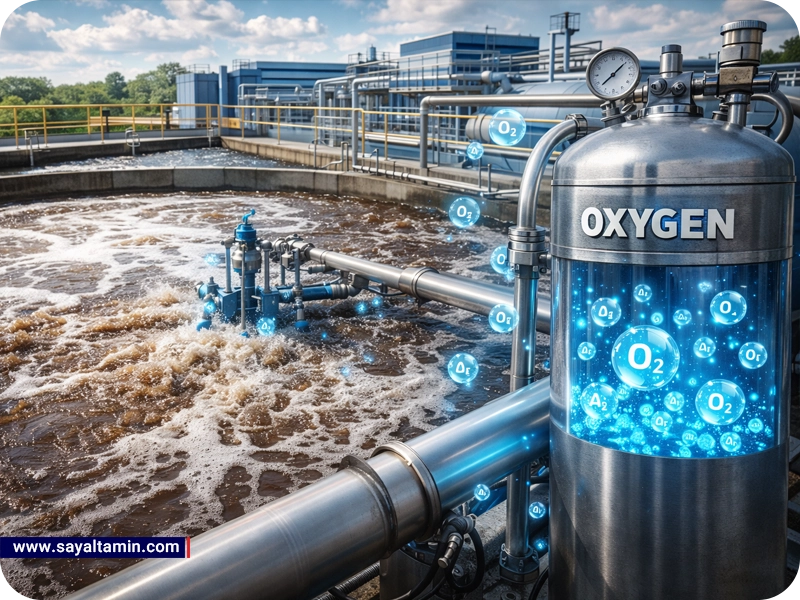
In contrast, the use of pure oxygen (typically >90% O₂) or oxygen-enriched air enables significantly higher dissolved oxygen concentrations without requiring a substantial increase in gas flow rate. This higher DO level allows microorganisms to oxidize organic matter at a much faster rate, leading to shorter stabilization times and a reduced volume of final sludge produced. Additionally, more stable biological conditions minimize the generation of odorous compounds and enhance overall environmental performance around the treatment facility.
From an operational perspective, pure oxygen provides greater process control. Operators can precisely adjust oxygen injection rates to maintain optimal microbial conditions and prevent performance fluctuations—particularly valuable in plants facing variable pollutant loads.
Impact of Oxygen on Reducing Excess Sludge Production
One of the most costly aspects of wastewater treatment plant (WWTP) operation is the management and disposal of excess sludge. Costs associated with dewatering, transportation, and final disposal can account for a significant portion of the annual budget. Any technology that reduces sludge volume offers substantial economic and environmental benefits.
In advanced aerobic processes using pure oxygen, the rate of endogenous respiration increases. This means microorganisms consume part of their own biomass to meet energy needs, resulting in a net reduction in sludge mass. More effective breakdown of complex organic compounds also decreases the amount of volatile solids remaining in the stabilized sludge.
Experimental studies indicate that oxygen-enriched or pure oxygen systems can reduce excess sludge production by 20–40% compared to conventional air-aerated aerobic digestion. This reduction not only lowers disposal costs but also decreases the size of required dewatering equipment and reduces the consumption of chemical polymers.
Beyond quantitative reduction, sludge quality improves significantly. Sludge from advanced aerobic digestion with pure oxygen is typically more stable, less odorous, and microbiologically safer, increasing opportunities for beneficial reuse in agriculture or soil remediation (provided regulatory hygiene standards are met).
Integration of Advanced Aerobic Digestion with Enhanced Biogas Production
At first glance, aerobic digestion might appear to conflict with biogas production (a product of anaerobic processes) due to its consumption of organic matter. However, in modern wastewater treatment systems, intelligent integration of aerobic and anaerobic stages can boost overall energy recovery efficiency.
In many advanced designs, aerobic digestion serves as a pretreatment step for sludge before it enters the anaerobic digester. This partial breakdown of microbial cell structures and complex organics makes substrates more accessible to methanogenic bacteria, increasing methane production rates in the anaerobic phase and reducing the required retention time.
Pure oxygen plays a pivotal role here, as the intensity and depth of aerobic decomposition depend directly on dissolved oxygen levels. Using pure oxygen enables more effective pretreatment in shorter times and with smaller reactor volumes, ultimately improving the conversion efficiency of organics into biogas in the subsequent anaerobic stage.
Furthermore, the reduced sludge mass entering the anaerobic digester (due to biomass loss in the aerobic phase) promotes more stable anaerobic operation, minimizing issues such as volatile acid accumulation and pH drops. This operational stability indirectly enhances biogas yields and reduces unplanned downtime.
Energy and Economic Considerations for Oxygen Use in Wastewater Treatment Plants
A primary concern for WWTP managers is the cost of supplying pure oxygen compared to compressed air. While oxygen generation or procurement involves upfront investment, a comprehensive energy and cost analysis often demonstrates economic justification.
In air-based aeration, a large fraction of energy is wasted compressing nitrogen, which contributes nothing to treatment. Pure oxygen systems require far lower gas volumes and achieve much higher oxygen transfer efficiency (OTE), significantly reducing blower and compressor power consumption.
Additional savings come from reduced sludge volumes (lowering dewatering, transport, and disposal costs) and increased biogas production in hybrid systems, which can offset energy needs or generate revenue. In some projects, biogas energy has covered a substantial portion of aeration and pumping electricity requirements.
For industrial gas suppliers like (Sayal Tamin Raham), expanding oxygen applications in the water and wastewater sector represents a stable, growing market. Long-term oxygen supply contracts for municipal treatment plants offer attractive economics while enhancing the environmental profile of the gas industry.
Safety and Infrastructure Requirements for Oxygen Use
The industrial application of pure oxygen demands strict adherence to safety protocols. While oxygen is non-flammable, it vigorously supports combustion and can dramatically increase fire risk in the presence of combustible materials. Therefore, oxygen injection systems in WWTPs must comply with industrial safety standards.
Essential infrastructure includes cryogenic or compressed gas storage tanks, vaporizers, compatible piping materials, and precise pressure/flow control systems. All equipment must be designed for oxygen-rich environments to prevent unintended reactions.
Operator training is critical: personnel must understand oxygen’s physical and chemical properties, potential hazards, and emergency response procedures. Leak detection, adequate ventilation in enclosed spaces, and monitoring systems are fundamental requirements.
The Role of Oxygen in Smart and Sustainable Wastewater Treatment Plants
As cities advance toward smart, sustainable infrastructure, WWTPs are evolving into highly energy-efficient facilities with minimal environmental impact. Priorities include renewable energy integration, material recovery, and waste minimization.
Pure oxygen serves as a key enabler for optimizing biological processes. Real-time DO control based on online wastewater quality data allows rapid adaptation to load variations, preventing excessive energy use.
Combining advanced oxygenation with biogas energy recovery can transform treatment plants into near-zero or even net-positive energy facilities. This approach not only cuts operating costs but also shifts WWTPs from energy consumers to energy producers.
The application of pure oxygen in advanced aerobic digestion of wastewater offers an effective solution for enhancing treatment efficiency, minimizing sludge production, and improving conditions for biogas generation in integrated municipal systems. By elevating dissolved oxygen levels, it optimizes microbial activity, accelerates organic matter breakdown, and reduces final biomass volume.
Economically, while pure oxygen supply requires initial investment, the benefits—lower aeration energy use, reduced sludge management costs, and higher biogas output—often provide payback in the medium term. This technology also creates new opportunities for industrial gas companies to play a prominent role in urban environmental projects.
Given escalating environmental regulations and the imperative for sustainable resource management, pure oxygen-based advanced aeration is poised to become an integral component of future wastewater treatment designs
————————————————–
Resources
1. Appels, L., Baeyens, J., Degrève, J., & Dewil, R. (2008). Principles and potential of the anaerobic digestion of waste-activated sludge. Progress in Energy and Combustion Science, 34(6), 755–781.
2. Metcalf & Eddy. (2014). Wastewater Engineering: Treatment and Resource Recovery (5th ed.). McGraw-Hill.
3. Tchobanoglous, G., Stensel, H. D., Tsuchihashi, R., & Burton, F. (2013). Wastewater Engineering: Treatment and Reuse. McGraw-Hill.
4. Khanal, S. K. (2008). Anaerobic Biotechnology for Bioenergy Production. Wiley-Blackwell.
5. Rosso, D., Larson, L. E., & Stenstrom, M. K. (2008). Aeration of large-scale municipal wastewater treatment plants. Water Science and Technology, 57(7), 973–978.
6. US EPA. (2013). Oxygen-Activated Sludge Process Design Manual. United States Environmental Protection Agency.