

This post is also available in: Persian Armenian
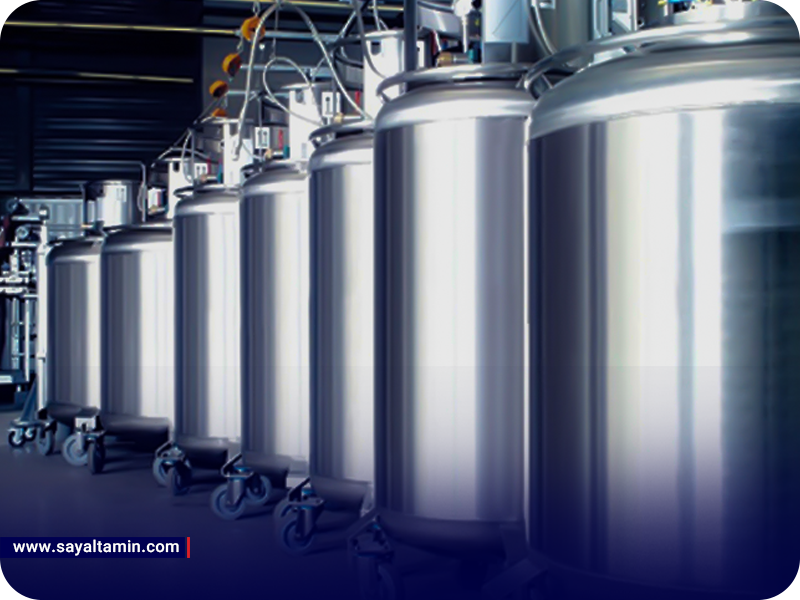
A Dewar storage vessel (the first vacuum flask was created by Scottish physicist and chemist James Dewar in 1892) is a specialized type of vacuum flask used for storing cryogens (such as liquid nitrogen or liquid helium) whose boiling points are much lower than room temperature (near absolute zero). Dewar storage vessels can come in various forms, including flasks (Dewars with loose caps) and pressure vessels.
All Dewars have walls made from two or more layers, with a high vacuum between the layers. This creates very high thermal insulation between the inside and outside walls, which reduces the evaporation rate of the contents inside the Dewar.
Safety Measures in Dewar Design for Safely Managing Gas Released due to Boiling Liquids:
- Simple Dewars: Allow gas to escape through an open section or vents to prevent explosion hazards.
- Complex Dewars: Trap gas above the liquid and hold it under high pressure. This raises the boiling point of the liquid and allows it to be stored in liquid form for a longer period. If excessive vapor pressure builds up, the gas automatically escapes through safety valves.
These containers are manufactured in compliance with DOT4L standards for transportation and storage, and are used for supplying cryogenic gases in a wide range of applications.

Dewar: Loss of Vacuum
Loss of vacuum in a liquid cylinder is typically associated with excessive freezing of the cylinder or a rapid increase in pressure. However, pressure increases can be normal. A new cylinder or one that has not been used recently will have a warm inner container. Newly filled cylinders rapidly increase pressure and discharge excess gas.
Low, Medium, and High-Pressure Dewars:
- Low-pressure Dewars are used for liquid discharge. Distribution from a medium or high-pressure Dewar is not recommended, as it can cause splashing or whipping of cryogenic liquids, increasing the risk of exposure and cryogenic burns. Only low-pressure Dewars should be used for liquid distribution.
- In a low-pressure Dewar, the pressure inside the container is maintained through pressure leakage. As the Dewar warms, the liquid evaporates (expanding approximately 700 times its liquid volume), which increases the internal pressure. When the pressure reaches 22 psi (1.5 bar), it is automatically released via a pressure-relief valve. If the release valve fails, the emergency rupture disk will discharge excess pressure to prevent further incidents.
- For gas consumption, medium and high-pressure Dewars are used (230 psi [15.9 bar] and 350 psi [24.1 bar]).
- For gas transfer, medium and high-pressure Dewars are used. These two Dewar types function similarly but differ in the cryogenic liquid volume they can hold.

Medium and high-pressure tanks increase internal pressure by using a vaporizer coil in the Dewar’s outer jacket. When the pressure valve is opened, the liquid enters the coil, heats up, evaporates, and becomes gas.
Plumbing and Function Controls
- Gas Consumption Valve & Vaporizer Circuit: For gas exit. When pressure is generated, you can release gas from the cylinder by opening the gas consumption valve.
- Liquid Consumption Valve: For liquid filling or withdrawal. Close the gas system valves first, then open the liquid valve to move liquid towards the discharge pipe.
- Pressure Control and Rupture Disk: Used for pressure regulation and control. The pressure control valve is often set to open at 230 psi, working with a rupture disk inside the container.
- Pressure Gauge: Indicates cylinder pressure. Pressure inside the Dewar increases as cryogenic liquids evaporate and turn into gas.
- Liquid Level Gauge: Indicates the liquid contents of the cylinder. A float-type gauge or differential pressure gauge can be used to measure liquid levels.
Safety
Cryogens pose several safety hazards, and storage vessels are designed to reduce the associated risks. First, no Dewar can create perfect thermal insulation, so cryogenic liquid slowly boils, generating a significant amount of gas. For example, cryogenic argon expands 847 times its volume from its boiling point to the ambient environment, while liquid hydrogen expands by 851 times, and liquid helium by 757 times. Cryogenic oxygen and nitrogen expand by 696 and 860 times, respectively.
In open Dewars, the gas simply escapes into the surrounding area. However, very high pressures can build up inside sealed walls, and precautions must be taken to minimize explosion risks. One or more pressure-relief valves allow the gas to escape whenever excessive pressure builds up.
If the Dewar is left open for too long, atmospheric chemicals can condense or freeze in contact with the cryogenic materials, introducing contaminants. When these materials freeze (e.g., water vapor turning into ice), they can block vents and lead to increased pressure and explosion hazards.
Gas escaping from a Dewar can displace oxygen from the surrounding air, creating a suffocation risk. Users are trained to store Dewars only in well-ventilated areas and to discharge excess gas before transporting Dewars.
Beware of Frost and Water
Since the building’s vaporizer coil contains cold liquid, the outer tank cools, causing severe frost buildup. Over time, the gas exit temperature drops significantly, and the outer surface of the Dewar becomes extremely frosty. This frost eventually turns to water, which can damage floors and seep into the facilities, causing more damage to systems.
Using a tray beneath the Dewar can help avoid these issues.
Precautions to be Taken While Using Dewars:
- Visually inspect the pressure relief valve. Ensure the valve is in place and unobstructed (not capped or blocked).
- Check for excessive ice buildup at the valves or other Dewar parts.
- Visually inspect the Dewar for any external damage or defects (e.g., dents).
- Before moving any pressurized Dewar, inspect the wheels for damage and ensure they’re suitable for the travel path.
- For distribution operations: Check that the distribution hose is correctly connected to the valve outlet. Only use hoses designed for cryogenic liquids.
- For gas operations: Ensure the gas regulator is properly connected to the gas consumption valve (refer to the UCalgary compressed gas cylinder standard for regulator installation and leak testing procedures).
.

Safety checks on Dewars under pressure are performed by previous staff during and after each filling, and records should be kept.
Liquid cylinders should always be stored and operated in a vertical position.
For loading (or unloading) a cylinder onto a truck, use an electric lift gate, crane, or sloped ramp. Never attempt to lift or remove a liquid cylinder manually from a truck bed.
Proper Cylinder Handling Methods
Preferred Lifting Method: Dewar liquid cylinders have a ring at the top, designed to protect the plumbing components. It should not be used for lifting or moving the cylinders. The ring is attached to the cylinder by two or four posts, each with a lift hole for lifting or trolley attachment.
To lift a liquid Dewar, attach the appropriate hooks and chains to both holes and lift vertically.
Be careful of the cold and water.
Since the pressurized building vaporizer contains cold liquid, it cools the external tank and it is quite normal for frost to form on the outside of the cylinder. During long-term traction, the gas outlet temperature will drop significantly and the outside of the cylinder will become severely frozen.
This frost eventually turns to water, which can damage flooring and also seep into the interstitial space of your facility to cause further damage to other systems. Using a drip tray under the door can save you a lot of trouble.
Things to keep in mind when using periods:
- Visually inspect the pressure relief valve. Make sure the valve is in place and not obstructed (capped or restricted).
- Check for excessive ice buildup in vents or other parts of the door.
- Visually inspect the outside of the door for any damage or defects (e.g. dents).
- Before moving any type of pressure washer, check the wheels for damage and suitability for the travel path.
- For dispensing operations: Check that the dispensing hose is properly connected to the dispensing valve outlet. Only use hoses designed to handle refrigerant fluids.
- For gas operation: Ensure that the gas regulator is properly connected to the gas supply valve (refer to the UCalgary Compressed Gas Cylinder Standard for Compressed Gas Regulator Installation and Leak Test Standard Operating Procedure)
- Extensive safety checks on the pressure cooker are carried out by the previous staff, during and after each filling. Records should be maintained.
- Do not roll the liquid cylinder by the displacement ring.
- Cylinders should always be stored and operated in a vertical position.
- When loading (or unloading) a cylinder onto a truck, use a powered lift gate, crane, or inclined ramp. Never attempt to manually lift or remove a liquid cylinder onto the truck bed.
Correct methods of cylinder handling
Preferred lifting method
Liquid dozers have a ring on the top of the liquid cylinder. The ring is designed to protect piping components and should not be used to move or lift liquid cylinders. The ring is attached to the cylinder with two or four posts. Each post has a lifting hole in it that can be used to lift or attach a trolley.
To lift the liquid cylinder, attach hooks and chains of the appropriate size to both holes and lift vertically. Figure A shows how a lifting system can be used to lift a liquid cylinder.

Figure B shows the methods of moving the cylinder when using a hand trolley. In this method, first approach the cylinder, then engage the pickup hook in the post slot, and after the hook and post slot engage, tilt the door back, and finally move and move the door. It should be noted that the approximate tilt position of the cart should be maintained when carrying the cylinder.

Figure C shows how a cylinder should be secured in a truck for transport. The use of safety straps prevents scratches on the surface and provides a reliable connection. Never use chains to secure the doors. Chain straps cause scratches and can cause the vacuum jacket to dent or shatter.
Figure C also shows the correct method for unloading or loading cylinders from a truck. Note that the electric lift gate must be used to move the hand trolleys and the liquid door to level.

Responsibilities of the distributor and refiller of liquid cylinders
1. The cylinder must be in a safe condition. The filler is responsible for verifying that each cylinder to be filled is in a suitable condition. These conditions include:
- Have an acceptable vacuum.
- The safety system and valves work well.
- There is no structural or visible damage to the cylinder.
- All warning labels are in place and legible.
2. Do not overfill the cylinder.
Cylinders should not be filled to more than the weight recommended by the tank manufacturer.
3. Distribute only to informed users.
The filler must ensure that the user is aware of the general characteristics of the product and the appropriate precautions for its use. Do not allow customers to fill their own cylinders.


 |
|
