
This post is also available in: Persian Armenian
In recent decades, the construction industry has become one of the largest consumers of energy and natural resources worldwide. Buildings contribute significantly to greenhouse gas emissions not only during their operational phase, but also throughout material production, transportation, installation, and ultimately demolition. In response to these challenges, the concepts of green buildings and, more broadly, the circular economy have entered the technical and policy discourse of the construction sector. Unlike the linear model of extract–consume–dispose, the circular economy focuses on recycling, reuse, and extending the service life of materials.
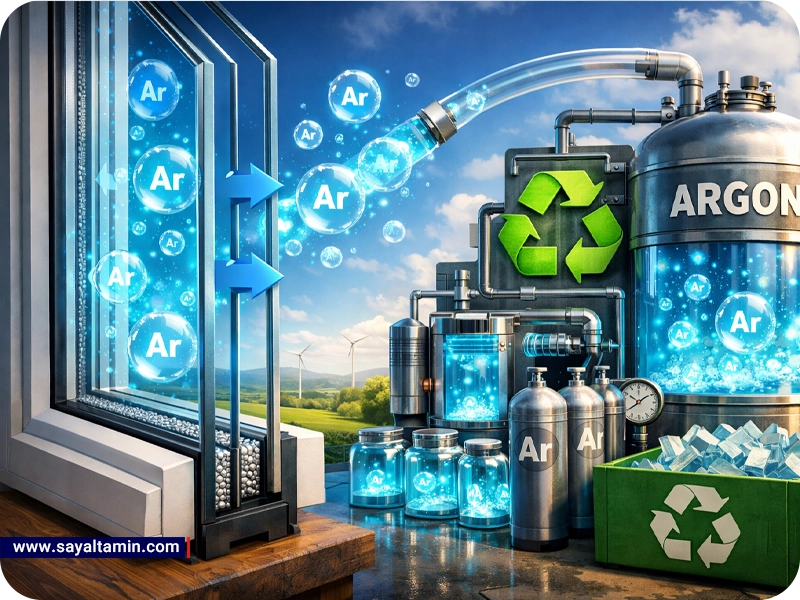
Within this context, double- and triple-glazed windows—widely used to improve thermal insulation—contain noble gases, particularly argon, in the space between glass panes. This gas plays a key role in reducing heat transfer; however, at the end of the windows’ service life, it is typically released into the atmosphere without recovery. Given that industrial argon production requires substantial energy input through air separation units, recovering argon from end-of-life windows can be considered a practical solution for reducing energy consumption, lowering industrial costs, and strengthening the circular economy value chain in the construction industry.
The Role of Argon in the Thermal Performance of Double-Glazed Windows
Double-glazed windows consist of two glass panes with the interspace filled with air or noble gases. The primary purpose of this design is to reduce heat transfer through conduction and convection. Compared to air, argon significantly lowers heat transfer due to its higher density and lower thermal conductivity.
Argon’s thermal conductivity is approximately 30% lower than that of air, which minimizes convective currents between the panes. As a result, the overall heat transfer coefficient of the window (U-value) decreases, leading to reduced energy demand for heating and cooling. For this reason, many modern building standards require or strongly recommend the use of gas-filled windows.
From an industrial perspective, the argon used in window applications must have relatively high purity to prevent moisture formation and undesirable chemical reactions. Consequently, the argon injected into windows is comparable in quality to argon used in many other industrial applications, making it theoretically suitable for recovery and reuse.
Lifecycle of Double-Glazed Windows and Gas Recovery Opportunities
The service life of double-glazed windows is typically estimated at 15 to 30 years, depending on manufacturing quality, climatic conditions, and maintenance practices. After this period, windows are replaced due to declining insulation performance, gas leakage, or frame degradation. During demolition or renovation processes, the primary focus is usually on recycling glass and metal frames, while little attention is paid to the gas trapped between the panes.
In most cases, the glass is broken and the argon is released uncontrollably into the atmosphere. Although argon is not a greenhouse gas and poses no direct environmental hazard, its re-production requires high electrical energy input in cryogenic air separation units. From an energy lifecycle and carbon footprint perspective, the uncontrolled release of unrecovered argon represents a significant loss of an energy-intensive industrial resource.
If controlled gas extraction systems are implemented during the collection of end-of-life windows, a substantial portion of the argon used in the construction sector could be reintroduced into the industrial consumption cycle. This approach is fully aligned with circular economy principles, as it relies on secondary resources rather than primary production.
Technologies for Argon Recovery from Double-Glazed Windows
Recovering argon from double-glazed windows presents specific technical challenges, as the gas volume per unit is relatively small and economic viability requires aggregation of large quantities. However, at an industrial scale and within dedicated construction recycling facilities, the process can become cost-effective.
The typical process involves several main stages. First, windows are transferred to separation units without completely shattering the glass. Through controlled perforation or removal of sealing joints, the trapped gas is directed into a collection system. The extracted gas is then transferred to temporary storage tanks and sent to purification units.
Since the recovered gas may contain small amounts of air, moisture, or other contaminants, molecular sieves, dryers, and adsorption systems are required to increase purity. If higher purity levels are needed, small-scale cryogenic distillation processes can also be applied, although this option involves higher capital costs.
Advances in gas compression and storage technologies have made it possible to aggregate and transport even dispersed gas volumes to centralized purification facilities. As a result, networks of collection centers can be integrated into the industrial gas supply chain.
Position of Argon Recycling in the Circular Economy of the Construction Industry
Traditionally, circular economy initiatives in construction have focused on recycling solid materials such as concrete, steel, and glass. However, gases trapped within building components also represent consumed resources that have received little attention to date. Argon recycling can serve as a successful example of extending circular economy principles to invisible consumable materials.
Integrating gas recovery into construction waste management chains requires cooperation among demolition companies, recycling facilities, window manufacturers, and industrial gas suppliers. In such a model, old windows are viewed not only as glass waste but also as a valuable source of industrial gas. This shift in perspective can lead to the creation of new markets for gas collection and purification services.
From a policy standpoint, incentives for gas recovery can be promoted through tax benefits, building standards, and waste management regulations. Particularly in large-scale urban renovation projects, the volume of replaced windows can be sufficient for gas recovery to play a tangible role in reducing primary resource consumption.
Environmental Benefits of Argon Recycling
Although argon itself has no direct greenhouse effect, its production is indirectly associated with carbon dioxide emissions due to the energy-intensive nature of air separation units, which often rely on electricity generated from fossil fuels. Therefore, every cubic meter of recycled argon represents a reduction in primary production demand and, consequently, lower energy consumption.
In addition, reduced demand for new argon production can alleviate pressure on industrial infrastructure and limit the need for expanding air separation capacity. This indirectly reduces natural resource use and the environmental impacts associated with constructing large industrial facilities.
From a waste management perspective, controlled gas recovery processes also contribute to safer and more structured demolition operations. This can help reduce glass particle dispersion and local pollution, as windows are processed for gas extraction before full fragmentation.
Economic Benefits for the Industrial Gas and Condensate Sectors
For companies active in industrial gases and gas condensates, recovering argon from double-glazed windows can serve as a complementary gas supply source. At a time when energy costs and capital expenditures for primary gas production are increasing, access to secondary resources can provide a competitive advantage.
Economically, the cost of collecting and purifying recycled argon is often lower than that of cryogenic production, particularly when aggregated volumes are significant. Moreover, companies participating in recycling chains can offer new value-added services such as construction waste gas management, gas purification, and the supply of low-carbon or “green” industrial gases for sustainable projects.
In international markets, the concept of industrial gases with a reduced carbon footprint is increasingly becoming a commercial advantage. Companies that can source part of their product portfolio from recycled streams will be better positioned in negotiations with major industrial customers, especially in advanced and export-oriented industries.
For gas condensate and energy-related companies, entering the circular economy domain can also strengthen brand image as an environmentally responsible actor—an increasingly important factor in attracting investors and participating in large national and international projects.
Technical and Logistical Challenges to Large-Scale Implementation
Despite its advantages, argon recovery from double-glazed windows faces several challenges. One of the main issues is resource dispersion. Unlike large industrial consumers where gas use is centralized, windows are installed across numerous buildings, requiring extensive logistics networks for collection.
Another challenge is gas leakage over the window’s service life. A portion of the argon gradually escapes through seals over time, reducing the amount available for recovery. This factor must be considered in economic calculations and system capacity design.
From a technical standpoint, maintaining gas quality during collection is critical. The ingress of moisture and air can increase purification costs and, in some cases, render reuse economically unfeasible. Therefore, collection equipment must be designed to minimize contamination.
Finally, the absence of clear standards for gas recovery from construction materials may hinder rapid industry development. Establishing technical and legal guidelines will play a crucial role in attracting investment.
Linking Argon Recycling to Green Building Concepts and Environmental Certifications
In green building rating systems such as LEED and BREEAM, the use of recycled materials and carbon footprint reduction are key evaluation criteria. While these systems have traditionally focused on solid materials, attention to the full lifecycle of building components is gradually increasing.
Within this framework, using windows filled with gas sourced from recycled argon can be presented as an environmental advantage in construction projects. This approach not only reduces primary resource consumption but also sends a clear signal of commitment to sustainability principles.
For window manufacturers, recycled argon can become part of a green marketing strategy. In a competitive construction materials market, offering products with sustainability labels can be a major differentiator—particularly in public and international projects with stringent environmental requirements.
The Role of Gas Supply Companies in Developing the Value Chain
Industrial gas and gas condensate companies, due to their existing infrastructure for gas storage, compression, and distribution, are ideally positioned to develop the argon recycling value chain. They can act as intermediaries between the construction industry and gas-consuming sectors.
By investing in purification and compression units, these companies can upgrade recovered argon to the quality levels required by various industries. Their experience in safe transportation of pressurized gases also significantly reduces operational risks across the chain.
Collaboration with demolition and construction recycling companies can lead to joint business models in which gas collection costs are offset by sales revenues. In such models, gas recycling can evolve from a side activity into a stable revenue stream.
Future Outlook and Development Pathways
As global focus on carbon reduction and resource efficiency intensifies, the recycling of industrial gases from end-of-life products is expected to gain increasing attention. In the future, windows may be designed to facilitate easier and lower-cost gas extraction at the end of their lifecycle—through dedicated recovery ports or detachable sealing materials.
The development of small-scale gas capture and separation technologies could also enable on-site recovery, particularly in large urban renovation projects. In such cases, recovered gas could be directly transferred to transport cylinders and integrated into industrial supply chains without moving windows to specialized facilities.
From a policy perspective, integrating gas recovery requirements into construction waste management regulations could play a decisive role in industry development. Experience from leading waste management countries shows that mandatory regulations combined with financial incentives are the most effective drivers of market behavior change.
Argon, as a key component of double-glazed windows, plays an important role in improving building energy efficiency. However, at the end of a window’s service life, this gas is typically released without recovery. Given the high energy demand of industrial argon production, recycling argon from end-of-life windows can reduce primary resource consumption, lower industrial costs, and strengthen circular economy principles.
For the construction sector, this approach extends the green building concept beyond design and operation to end-of-life material management. For industrial gas and gas condensate companies, argon recycling represents an opportunity to develop sustainable supply sources, create competitive advantages, and strengthen positioning in green markets.
Despite technical and logistical challenges, continued technological progress and appropriate policy frameworks can make argon recycling from double-glazed windows a key component of a sustainable future construction value chain—one in which even invisible gases have a defined place in the circular economy.
Table 1 – Comparison of Primary Argon Production and Argon Recycling from Double-Glazed Windows
| Comparison Criteria | Primary Argon Production (Air Separation) | Recycling from Double-Glazed Windows |
|---|---|---|
| Gas Source | Ambient air | End-of-life building windows |
| Energy Consumption | Very high (cryogenic units) | Medium to low (compression & purification) |
| Initial Capital Investment | High | Medium |
| Carbon Footprint | High | Lower |
| Dependence on Large Infrastructure | High | Scalable at regional level |
| Alignment with Circular Economy | Limited | Very high |
| Green Market Development Potential | Medium | High |
————————————————–
References
• European Commission.
Circular Economy Action Plan: For a Cleaner and More Competitive Europe.
Brussels: European Union, 2020.
→ Policy framework for circular economy in construction and material recovery.
• International Energy Agency (IEA).
Energy Efficiency in Buildings: Windows and Building Envelopes.
Paris: IEA Publications, 2022.
→ Discusses performance of insulated glazing units (IGUs) and role of gas fills such as argon.
• Pilkington Glass.
Argon Gas in Insulating Glass Units: Performance and Durability.
Technical Bulletin, NSG Group, 2019.
→ Explains why argon is used in double-glazed windows and long-term gas retention.
• Saint-Gobain Glass.
Insulating Glass Units and Gas Filling Technologies.
Technical Documentation, 2021.
→ Industrial process of gas filling and sealing in glazing productio