

This post is also available in: Persian Armenian
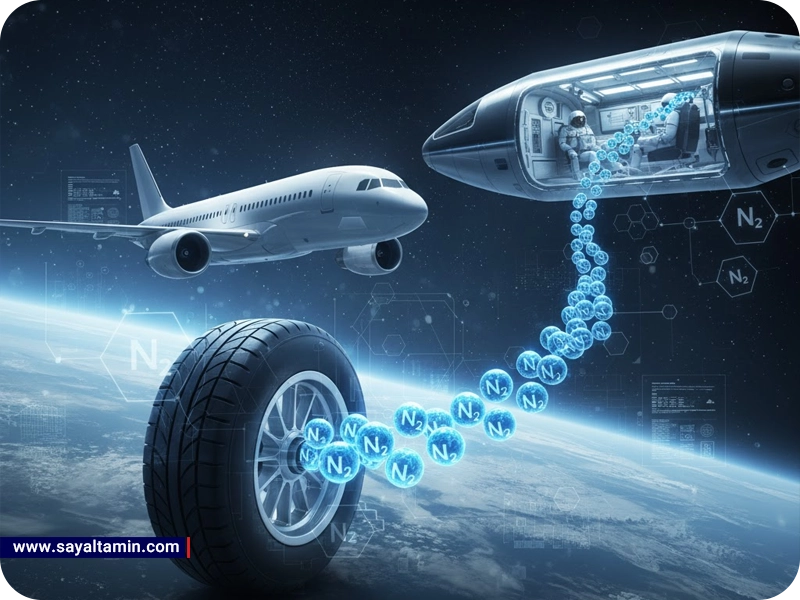
The aerospace industry, with its stringent requirements for safety, performance, and reliability, is constantly looking for materials and gases that can meet these standards. Nitrogen (N2) has a special and vital place in this industry due to its unique properties. From controlling the pressure in airplane tires to maintaining a safe environment in spacecraft, nitrogen plays a multifaceted role, which we will discuss in detail in this article.
Key properties of nitrogen and its relevance to aerospace
Nitrogen, which makes up about 78 percent of the Earth’s atmosphere, is a colorless, odorless, and nonflammable gas. These inherent properties make it an ideal choice for many sensitive aerospace applications. Some of its most important properties include:
• Inertness: Nitrogen generally does not react with other materials. This property distinguishes it from oxygen, which is highly reactive and can cause combustion. In aerospace environments where we deal with flammable fuels and sensitive electronic components, the use of an inert gas significantly increases safety.
• Temperature stability: Nitrogen maintains its properties over a wide range of temperatures, from very low temperatures (as a liquid) to high temperatures. This stability is critical for applications such as cooling systems and thermal control.
• Density and pressure: Nitrogen can be compressed to high pressures and has a suitable density, making it suitable for filling tires and pneumatic systems.
• Moisture absorption: In some cases, nitrogen can act as a drying agent and absorb moisture, which is useful in preventing freezing or corrosion of parts.
| Must read: Liquid oxygen in the shipping and navigation industry |  |
Various applications of nitrogen in the aerospace industry
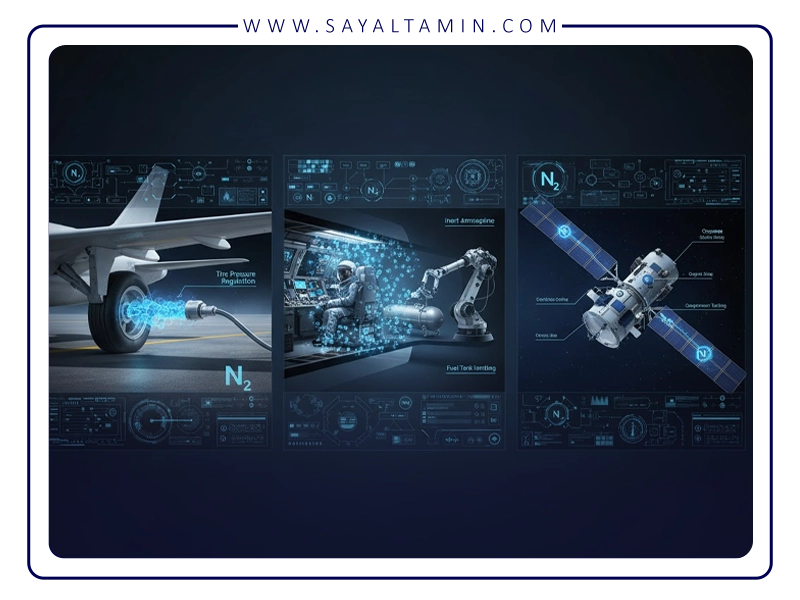
Nitrogen is used in various aspects of the design, construction, maintenance, and operation of aircraft and spacecraft:
1. Pressure control and stabilization:
• Aircraft tires: One of the most common uses of nitrogen in aircraft is to fill their tires. Unlike regular air, which contains moisture and oxygen, dry, pure nitrogen minimizes pressure changes caused by temperature changes. This makes tire pressure more stable during flight, which in turn increases safety and reduces tire wear. Nitrogen also reduces the risk of fire in the event of a tire puncture, as it is non-flammable.
• Hydraulic and pneumatic systems: In aircraft hydraulic and pneumatic systems used to control flight surfaces, landing gear, and other mechanisms, nitrogen is used as a compressed gas to maintain pressure and absorb shock. This helps these systems operate smoothly and accurately.
• Fuel tanks: To prevent the formation of flammable mixtures in the fuel tanks of aircraft and spacecraft, a nitrogen atmosphere is created (purging). This process, also called “inerting,” completely eliminates the risk of fire or explosion by replacing oxygen with nitrogen.
2. Purging & Cleaning:
• Purging fuel lines and systems: Before filling fuel tanks or repairing sensitive systems, nitrogen is used to purge and remove moisture, dust, and other debris. This process ensures that no contaminants or materials remain that could damage components.
• Protecting electronic components: During the manufacturing and assembly process, sensitive electronic components on aircraft and spacecraft may be exposed to moisture or airborne contaminants. Using nitrogen as a protective atmosphere protects these components from corrosion and damage.
3. Cooling and thermal control systems:
• Cooling of sensitive components: In spacecraft and satellites, electronic components and critical systems are exposed to extremely high temperatures. Liquid nitrogen (LN2) is a very effective cooling agent due to its extremely low boiling point (-196°C). It is used to cool infrared sensors, powerful processors, and other components that require low temperatures.
• Cabin thermal control: In some aircraft thermal control systems, nitrogen can play a role in regulating cabin temperature and maintaining optimal conditions for crew and passengers.
4. Space Operations and Propulsion:
• Breathing and life support systems: In spacecraft, a mixture of gases is used for astronauts to breathe. While oxygen is the main element, nitrogen is also used as a diluent gas and to regulate the overall atmospheric pressure of the cabin.
• Nitrogen propulsion: Some spacecraft and satellite control and maneuvering systems use nitrogen-based propulsion. In these systems, compressed nitrogen or liquid nitrogen acts as the fuel and, when exiting the nozzle, provides the thrust necessary to change the direction or position of the spacecraft. These systems are very popular due to their simplicity and high reliability.
5. Testing and Simulation:
• Pressure testing: Nitrogen is used as a test gas in the process of testing the strength and safety of fuel tanks, pipes, and other pressurized components in aircraft and spacecraft. Because it is inert and non-flammable, it is considered a safer alternative to air or oxygen in these tests.
• Creating a vacuum environment: In some tests related to simulating space conditions, nitrogen is used to evacuate air and create a vacuum environment.
6. Modern research and advanced materials:
• Composite materials: In the production process of advanced composite materials used in the construction of aircraft bodies and lightweight components, nitrogen is sometimes used to control temperature and prevent oxidation during the curing of the materials.
• Future Fuel Systems: Research continues to develop new and more efficient fuel systems in the aerospace industry, and nitrogen is being explored as a component or energy carrier in some of these designs.
Benefits and challenges of using nitrogen
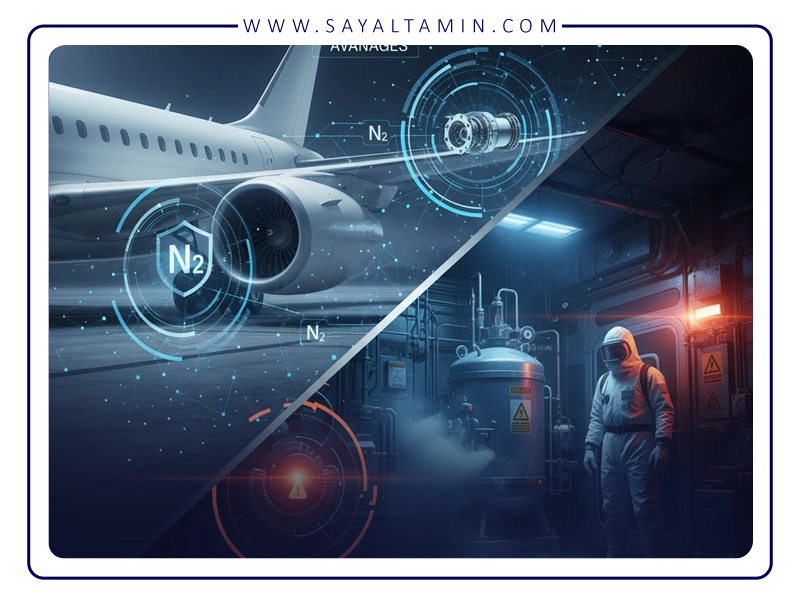
The widespread use of nitrogen in aerospace comes with significant benefits:
• Increased safety: Its inertness and non-flammability greatly reduce the risks of fire and explosion.
• Increases equipment life: Preventing corrosion and oxidation by removing moisture and oxygen increases the useful life of components and systems.
• Improved systems performance: The pressure and temperature stability resulting from the use of nitrogen helps critical aircraft systems operate more accurately and optimally.
• Easy availability and abundance: The abundance of nitrogen in the atmosphere makes its extraction and production relatively easy and cost-effective.
However, there are also challenges in using nitrogen:
• Liquid nitrogen hazards: Liquid nitrogen (LN2) has a very low temperature and direct contact with the skin can cause severe frostbite. Also, its rapid evaporation in enclosed environments can reduce oxygen concentrations and pose a risk of suffocation. Therefore, working with liquid nitrogen requires strict safety protocols, appropriate protective equipment, and strong ventilation systems.
• Storage and transportation costs: Storing and transporting nitrogen, especially in its liquid state, requires specialized and insulated equipment, which can be costly. Insulation and thermal management systems are essential to maintain the nitrogen in a liquid state and prevent its evaporation.
• Need for specialized equipment: On-site generation of nitrogen or purchasing it from external sources requires investment in the necessary equipment and infrastructure.
| Read more: Applications of cryogenic condensate |  |
Nitrogen gas, with its unique set of physical and chemical properties, has become one of the mainstays of the aerospace industry. From ensuring flight safety through tire pressure control to maintaining the critical performance of complex systems in spacecraft, the role of this inert and versatile gas is undeniable. Despite the challenges associated with using liquid nitrogen, the safety, reliability, and performance benefits that nitrogen brings have made it an essential and valuable gas in this leading industry. As technology advances and space exploration expands, it is expected that more innovative applications for nitrogen in the aerospace industry will be discovered and developed.
————————————————–
References