
This post is also available in: Persian Armenian
Light-emitting diode (LED) lamps, as one of the most important lighting technologies of the 21st century, have played a significant role in reducing energy consumption, increasing luminous efficiency, and minimizing environmental impacts. However, the stable performance and long lifespan of these lamps are not solely dependent on the quality of the semiconductor chip; they also rely on a combination of thermal, chemical, and environmental factors, one of the most critical being the use of inert gases within the lamp structure. Among these, argon gas, due to its unique physical and chemical properties, has a special role in enhancing efficiency, maintaining optical stability, and extending the lifespan of LED lamps.
In recent decades, the lighting industry has undergone a fundamental transformation. The gradual replacement of incandescent and fluorescent lamps with LEDs has not only significantly reduced energy consumption but also set new standards for lifespan, safety, and light quality. At first glance, one might assume that LED performance depends solely on semiconductor technology and electronic design; however, the internal structure of these lamps includes a combination of materials, coatings, and controlled environments, each of which plays a crucial role in final performance.
One of the less visible but highly influential factors is the gaseous environment inside the lamp. The presence of oxygen, moisture, or reactive gases can, over time, degrade the LED chip, reduce luminous flux, alter light color, and even cause complete lamp failure. For this reason, professional manufacturers use inert gases to create a stable, controlled environment around sensitive components.
Among these, argon gas is one of the most common and cost-effective noble gases, widely used in the lighting industry, particularly in the production of high-quality LED lamps. Argon is not only chemically inert but also has physical properties, including suitable thermal conductivity and high stability under various operating conditions, making it an ideal choice for this application.
Why studying the role of argon in LED lamps is important
The importance of understanding argon’s role in LED technology can be examined from several perspectives. On one hand, increasing lamp lifespan and efficiency is directly related to reducing maintenance, replacement, and energy costs. On the other hand, in industrial, urban, and commercial lighting projects, performance stability is a key factor in economic decision-making.
For companies involved in the supply and sale of industrial gases and gas condensates, understanding advanced applications of argon in industries like LED lighting provides a valuable opportunity to expand the market, increase product value, and offer specialized solutions to industrial customers.
Introduction to argon gas and its properties
Argon, a member of the noble gas family, has the chemical symbol Ar and atomic number 18. Under standard conditions, it is a colorless, odorless, and tasteless gas. Argon makes up approximately 0.93% of the Earth’s atmosphere and, due to its inert nature, is widely used across various industries, including lighting, welding, electronics, and semiconductor manufacturing.
A key property of argon is its chemical inertness. This means that under normal conditions, argon does not react with other materials, providing excellent stability against oxidation or material degradation. This property directly protects sensitive LED components, such as semiconductor chips and epoxy coatings, from chemical damage.
Another important property is argon’s higher density compared to air. This allows argon to create a stable, protective environment around the internal lamp components, preventing the infiltration of moisture or reactive gases. Additionally, argon’s relatively low thermal conductivity helps manage heat, preventing unwanted heat transfer to sensitive components.
From an operational perspective, argon is chosen in the lighting industry for the following reasons:
- Extended lamp lifespan: By preventing oxidation and thermal degradation
- Optical stability: Maintaining light intensity and color over time
- Safety and non-toxicity: Argon is non-flammable and non-toxic, making it safe for use in enclosed environments
- Availability and cost-effectiveness: Compared to other noble gases like neon or krypton, argon is widely available and relatively inexpensive
Internal structure of LED lamps and gas-sensitive points

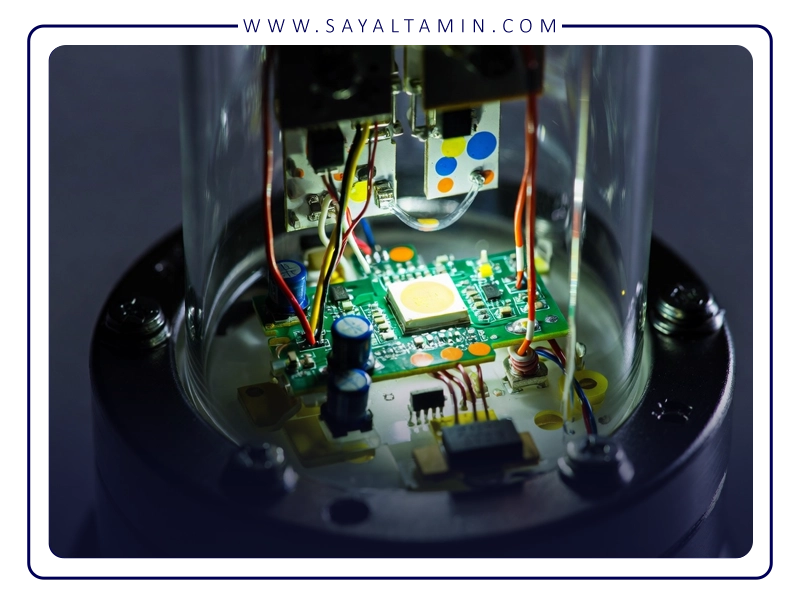
LED lamps consist of several main components, each playing a vital role in the lamp’s overall performance and lifespan: the semiconductor chip, lens or epoxy coating, base, and heat sink (thermal converter).
The semiconductor chip, the heart of LED illumination, directly generates light. During operation, it is exposed to high temperatures and, if in contact with oxygen or moisture, may gradually experience oxidation or thermal degradation. The epoxy coating or lens surrounding the chip not only shapes the emitted light but also protects it from environmental factors.
The heat sink is responsible for transferring the heat generated by the chip to the surroundings, and inadequate thermal management can reduce luminous efficiency and damage internal components.
In this context, the gaseous environment inside the lamp—often filled with argon—serves multiple protective functions:
- Prevention of oxidation: Argon displaces air and removes oxygen, preventing chemical degradation of components.
- Thermal management: Argon’s low thermal conductivity reduces unwanted heat transfer to the chip and epoxy.
- Reduction of internal stress: Argon’s suitable density helps minimize mechanical stress caused by thermal expansion.
- Maintaining optical stability: By preventing the ingress of moisture and reactive gases, the LED’s light intensity and color remain stable over time.
In other words, the correct selection of the internal gas is not merely a technical detail but a key strategy in ensuring LED lifespan and performance quality.
The role of argon in thermal management and preventing heat-induced degradation
One of the main challenges in LED lamps is managing the heat produced by the semiconductor chip. LEDs generate significant energy as heat during operation. If this heat is not effectively dissipated from the chip’s surroundings, internal temperatures rise, leading to reduced luminous efficiency, color shifts, and shorter lifespan.
The presence of argon inside the lamp, as an inert gas with low thermal conductivity, plays a critical role in mitigating these negative heat effects. Specifically, argon creates a low-conductivity environment that controls heat transfer to the heat sink, protecting sensitive chip areas.
Industrial studies show that using argon in LED lamps can lower the chip surface temperature by an average of 5–10°C. Although this temperature reduction may seem small, it has a significant impact on LED lifespan:
- Typically, every 10°C increase in temperature can reduce LED lifespan by approximately 20%.
- A 5–10°C temperature reduction due to argon can increase lamp lifespan by 10–20%.
In other words, replacing air or other non-ideal gases with argon not only prevents thermal damage but also helps maintain consistent luminous flux and preserves light quality over time.
From a practical perspective, this benefit allows manufacturers and users to:
- Reduce maintenance and replacement costs
- Ensure stable lighting performance in industrial and urban projects
- Increase customer satisfaction, as lamps experience less light decay and color change
Argon’s impact on optical stability and LED lifespan
Due to their semiconductor design and high luminous efficiency, LED lamps naturally generate heat and are sensitive to environmental conditions. Over time, exposure to oxygen, moisture, and reactive particles can degrade the epoxy coating, oxidize the chip, and alter the light spectrum. Such effects not only reduce lamp performance but can also lead to premature failure and decreased consumer trust in lighting products.
Using argon inside the lamp is an effective solution to these challenges. Argon performs several key roles in LED performance:
1- Chemical protection of sensitive components:
Argon is inert and displaces oxygen, preventing oxidation of the chip and metal components. This helps maintain light intensity and color stability over time.
2- Internal thermal control:
Argon’s low thermal conductivity ensures heat generated by the chip is transferred uniformly and controllably to the heat sink. Even a small reduction in chip surface temperature can significantly extend LED lifespan. Industrial studies indicate a 5–10°C temperature reduction can increase lamp lifespan by 10–20%.
3- Maintaining optical stability and color consistency:
By limiting moisture ingress and preventing chemical reactions, argon reduces ΔCCT (color temperature shift) over time. This is especially important for industrial and urban lighting that requires uniform, consistent illumination.
These effects collectively enhance consumer confidence and reduce maintenance costs.

Longer lifespan and higher optical stability not only reduce replacement and maintenance costs but also increase user satisfaction. From a commercial and economic perspective, this creates a competitive advantage for manufacturers and industrial gas suppliers.
Expanded Table: Comparison of LED Lifespan and Light Intensity in Air vs. Argon Environments
| Indicator | Air Environment | Argon Environment | Effect of Argon |
|---|---|---|---|
| Useful lifespan (hours) | 25,000 | 30,000 | ~20% increase due to reduced oxidation and better thermal management |
| Light intensity drop after 10,000 hours | 15% | 7% | Higher luminous flux retention in argon environment |
| Color shift (ΔCCT) | 400 K | 150 K | Reduced color change due to chemical and thermal protection |
| LED chip temperature (during operation) | 85°C | 78°C | ~7°C reduction in chip surface temperature due to low thermal conductivity of argon |
| Moisture resistance | Low | High | Prevents moisture ingress and degradation of epoxy and chip |
| Long-term stability in industrial environment | Medium | High | Argon environment maintains uniform performance even in challenging industrial conditions |
| Operational maintenance cost | Higher | Lower | Fewer replacements and less light quality degradation |
Comparison of Argon with Other Gases Used in the Lighting Industry
In LED production, besides argon, other noble gases such as neon, krypton, and xenon are also used. Each gas has its own advantages and limitations, but argon, due to its optimal combination of physical, chemical, and economic properties, is the dominant choice in the lighting industry.
Advantages of Argon over other noble gases:
- Chemical inertness: Like other noble gases, argon is non-reactive, but it is more cost-effective than krypton and xenon.
- Suitable density: Argon’s density is ideal for creating a protective environment and reducing moisture and oxygen ingress.
- Low thermal conductivity: Ensures controlled heat transfer from the LED chip and prevents thermal degradation.
- Cost and availability: Argon is widely available and affordable, making its widespread industrial use feasible.
Comparative Table: Properties and Applications of Noble Gases in LED Lamps
| Feature / Gas | Argon (Ar) | Neon (Ne) | Krypton (Kr) | Xenon (Xe) |
|---|---|---|---|---|
| Chemical inertness | Yes | Yes | Yes | Yes |
| Density (g/L) | 1.784 | 0.900 | 3.749 | 5.894 |
| Thermal conductivity | Low | Lower | Medium | Medium |
| Chip oxidation reduction | High | Medium | High | High |
| Thermal control | Effective | Less effective | Effective | Effective |
| Effect on light stability | High | Medium | High | High |
| Production cost and availability | Low/Medium | Medium | High | High |
| Common use in LEDs | Widespread | Limited | Limited | Limited |
As the table shows, argon provides a combination of chemical stability, suitable density, effective thermal management, and cost efficiency, making it the best choice for the internal environment of LED lamps. In contrast, krypton and xenon, though having similar properties, are mostly used in specialty lamps due to higher costs and limited availability. Neon, with lower density and limited thermal protection, is less ideal for high-efficiency LEDs.
Industrial, Economic, and Supply Chain Considerations for Argon
The LED lighting industry depends not only on the technical quality of the lamps but also on the selection of the internal protective gas and its supply chain management, which significantly affects costs, product quality, and production stability. Argon, with its unique combination of physical and chemical properties, widespread availability, and reasonable cost, provides substantial advantages to manufacturers and gas suppliers.
Importance of Argon in Industrial Processes
For a standard LED lamp, the gas consumption is approximately 5–10 mL per lamp. On a factory scale, producing one million lamps per month requires roughly 5,000–10,000 liters of compressed argon. Choosing a stable and readily available gas like argon ensures:
- Consistent production quality
- Prevention of production delays due to gas shortages
- Reduced risk of additional costs from substituting more expensive gases
Economic Advantage of Argon
According to industrial data, the cost of using argon for a single LED lamp is less than $0.05, whereas using krypton or xenon for the same gas volume can raise the cost to around $0.50 per lamp. This difference, when scaled to mass production, results in substantial cost savings.
Role of Supply Chain and Argon Availability
Argon, as a widely used industrial gas, is highly accessible, with most of it extracted from compressed air. This ensures that LED manufacturers face fewer concerns about market fluctuations and can plan long-term production and supply.
Furthermore, companies in the industrial gas and liquefied gas sector can provide high-quality argon to not only meet the technical needs of industrial customers but also demonstrate its direct impact on LED lifespan and light stability, thereby offering a competitive advantage and added value to clients.
Example
Consider a municipal lighting project with 10,000 LED lamps. Choosing argon instead of air or expensive gases can result in:
- An increase in lamp lifespan by approximately 20%
- Maintenance and replacement cost savings of around $50,000
- Improved light uniformity and reduced user complaints
This example shows that argon is not just a technical necessity but also a smart economic and marketing strategy for manufacturers and gas suppliers.
By comprehensively examining the internal structure of LED lamps, the physical and chemical properties of argon, and its impact on performance, lifespan, and optical stability, it becomes clear that using argon is not only a technical choice but also a strategic economic and industrial decision.
Practical Message for Manufacturers and Industrial Customers
- Choosing the appropriate gas for the internal environment of LEDs is a critical technical decision that directly affects lifespan and light quality.
- Argon, due to its optimal combination of chemical inertness, suitable density, thermal management, and cost-effective availability, is the first-choice gas for industrial and commercial LED lamps.
- Using argon not only reduces maintenance and replacement costs but also ensures customer satisfaction and reliable lighting project performance.
- Ultimately, argon, as a strategic industrial gas, bridges technical performance and economic advantage in the LED lighting industry, making its importance for manufacturers and gas suppliers undeniable.
————————————————–
resource
-Schubert, E. F. Light-Emitting Diodes, 3rd Edition, Cambridge University Press, 2018.
– Narendran, N., LED Lighting: Technology and Applications, CRC Press, 2016.
-Holonyak, N., & Bevacqua, S. F., Electroluminescence in GaAs Junctions, Applied Physics Letters, 1962.
-Pust, P., Materials for LED Phosphors, Journal of Luminescence, 2020.
-Cho, J., et al., Effect of Inert Gas Atmosphere on LED Performance, IEEE Transactions on Electron Devices, 2019.
-ASM International, Handbook of Gases in Electronics and Lighting Industries, 2017.