
This post is also available in: Persian Armenian
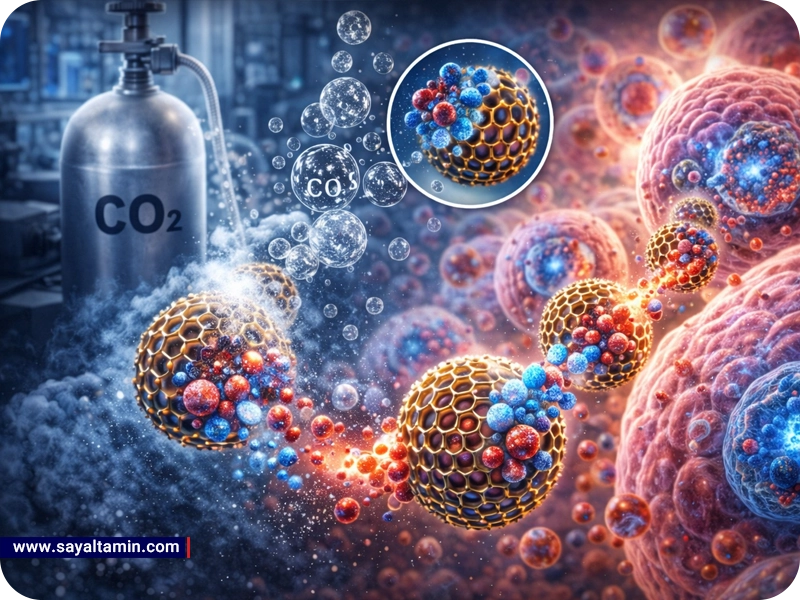
In recent decades, nanotechnology has emerged as one of the most transformative scientific and industrial fields, playing a decisive role in the development of advanced therapeutic approaches. One of the major challenges in pharmaceutical treatments is the effective, safe, and targeted delivery of drugs to specific tissues or cells, while maximizing therapeutic efficacy and minimizing side effects. In this context, the use of carbon dioxide (CO₂), particularly under supercritical conditions, has attracted significant attention as a novel medium and tool for the design and production of nano-scale drug delivery systems.
Carbon dioxide, commonly known as a greenhouse gas or a byproduct of combustion processes, has found entirely different and highly valuable applications in advanced fields such as pharmaceuticals, materials engineering, and nanotechnology. Properties such as non-toxicity, non-flammability, wide availability, relatively low cost, and the ability to finely tune its physical characteristics by adjusting temperature and pressure have made CO₂—especially in its supercritical state—an attractive option for sensitive pharmaceutical processes.
Carbon Dioxide: From a Simple Gas to an Advanced Nanotechnology Tool
Under normal conditions, carbon dioxide is a colorless and odorless gas; however, its thermodynamic behavior at elevated pressures and temperatures has opened new horizons in advanced technologies. The critical point of CO₂ occurs at approximately 31.1 °C and 73.8 bar. Beyond this point, CO₂ enters a supercritical phase—a state that is neither purely gas nor liquid, yet exhibits characteristics of both phases simultaneously.
In its supercritical state, CO₂ possesses a liquid-like density combined with gas-like diffusivity. This unique combination allows it to function effectively as a solvent or antisolvent in nanoscale fabrication processes. Moreover, by precisely controlling pressure and temperature, the solvation power and mass transfer behavior of CO₂ can be finely adjusted—an essential advantage in sensitive pharmaceutical applications.
Nanotechnology-Based Drug Delivery: Why Are New Approaches Needed?
Conventional drug delivery methods often suffer from limitations such as non-specific distribution within the body, premature degradation of active pharmaceutical ingredients, the need for high dosages, and the occurrence of adverse side effects. Nanotechnology-based drug delivery seeks to overcome these challenges through the design of nanoparticles, nanocapsules, and nanoliposomes that enable controlled and targeted delivery to specific sites.
In this context, the method used to produce nanocarriers is of critical importance. The use of toxic organic solvents, high processing temperatures, or harsh chemical conditions can lead to drug degradation or harmful residual impurities in the final product. This is where supercritical carbon dioxide emerges as a safe, environmentally friendly, and effective alternative.
The Role of Supercritical Carbon Dioxide in the Production of Pharmaceutical Nanocarriers
Supercritical carbon dioxide can be employed in various processes such as particle precipitation, drug encapsulation, and surface modification of nanoparticles. In these applications, CO₂ may act as a solvent, antisolvent, or mass transfer agent, depending on the process design.
One of the most widely used approaches involves employing supercritical CO₂ as an antisolvent. In this method, the drug and carrier polymer are dissolved in an organic solvent, after which supercritical CO₂ is introduced into the system. By reducing the solubility of the organic solvent, CO₂ induces rapid and uniform precipitation of nanoparticles. The result is the production of particles with controlled size, narrow size distribution, and minimal residual solvent content.
Types of CO₂-Based Pharmaceutical Nanocarriers
Nanotechnology-based drug delivery encompasses a wide range of carrier structures, many of which can be produced or optimized using CO₂-assisted processes. These include polymeric nanoparticles, nanolipids, nanocapsules, and nanogels.
In polymeric nanoparticles, supercritical CO₂ enables the production of particles smaller than 200 nanometers, which is critical for crossing biological barriers such as the blood–brain barrier. In lipid-based nanocarriers, the use of CO₂ can enhance lipid structure stability and improve drug loading capacity.
Comparative Table: Conventional Pharmaceutical Nanocarrier Production Methods vs.
| Feature | Conventional Organic Solvent-Based Methods | Supercritical CO₂-Based Method |
|---|---|---|
| Environmental Safety | Low to moderate | High (green technology) |
| Residual Solvent | Likely and potentially problematic | Very low or near zero |
| Particle Size Control | Limited | Highly precise |
| Process Temperature | Often high | Near ambient temperature |
| Suitability for Sensitive Drugs | Limited | Highly suitable |
Advantages of Using Carbon Dioxide in Nano-Drug Delivery
Key advantages of using CO₂ include reduced consumption of toxic solvents, preservation of drug chemical structure, higher drug loading efficiency, and strong potential for industrial-scale production. These benefits create new opportunities for companies involved in the supply and distribution of industrial gases and gas condensates to enter the pharmaceutical and biotechnology value chain.
Challenges and Limitations
Despite its many advantages, the use of supercritical carbon dioxide is not without challenges. The requirement for high-pressure equipment, significant initial capital investment, and complex process control are among the main barriers to large-scale industrial adoption. Additionally, not all drugs exhibit sufficient solubility or compatibility with CO₂, necessitating customized process design.
Industrial and Commercial Outlook
With the growing demand for targeted and personalized medicines, nanotechnology-based drug delivery is expected to play an increasingly prominent role in the coming years. In this landscape, carbon dioxide—when positioned as a high-value industrial gas—can secure a strategic role in the development of advanced pharmaceutical technologies.
Applications of Carbon Dioxide in Advanced Nano-Drug Delivery
In recent years, research focus has shifted from laboratory-scale studies toward clinical applications of nanotechnology-based drug delivery. Supercritical carbon dioxide plays a pivotal role in developing systems that enable controlled drug release, enhanced bioavailability, and reduced systemic toxicity. One of the most significant advantages of CO₂-assisted processes is the ability to produce nanoparticles with uniform and highly reproducible structures—an essential factor for regulatory approval and industrial manufacturing.
In modern drug delivery systems, nanocarriers are designed to release drugs in response to specific stimuli such as pH changes, temperature variations, or enzymatic activity. The use of CO₂ during nanocarrier fabrication allows precise tuning of both physical and chemical carrier properties. This level of control is particularly critical for drugs with narrow therapeutic windows.
The Role of CO₂ in Nanocarrier-Based Anticancer Drug Delivery
In cancer therapy, one of the primary challenges is delivering anticancer drugs directly to tumor tissues while minimizing damage to healthy cells. Polymeric and lipid-based nanoparticles produced using supercritical CO₂ enable efficient loading of chemotherapeutic agents. These nanoparticles can be directed to tumors either passively—through the enhanced permeability and retention (EPR) effect—or actively via targeting ligands.
CO₂-based processes allow heat- or light-sensitive drugs to be encapsulated without compromising their molecular structure. Studies have shown that anticancer drugs loaded using these methods exhibit improved stability and more controlled release profiles compared to conventional techniques, potentially reducing required dosages and significantly lowering side effects.
Applications in Biopharmaceuticals and Protein-Based Drugs
Biopharmaceuticals such as proteins, peptides, and RNA molecules are highly sensitive to environmental conditions. Exposure to organic solvents or elevated temperatures during processing can lead to denaturation. Supercritical carbon dioxide, by providing mild processing conditions, represents an ideal platform for producing nanocarriers compatible with biopharmaceuticals.
In these applications, CO₂ not only serves as a processing medium but also contributes to controlling the nanocarrier microstructure. The outcome is enhanced biopharmaceutical stability and improved storage and transportation performance—factors of critical importance in pharmaceutical supply chains.
Industrial Considerations and Process Scalability
One of the main challenges in translating nanotechnologies from laboratory research to industrial production is process scalability. CO₂-based technologies, due to their continuous operation and precise parameter control, offer strong potential for large-scale manufacturing. Notably, much of the required equipment is similar to that used in gas processing and petrochemical industries, reducing both learning curves and capital costs.
For companies involved in the supply of gas condensates and industrial gases, this technological overlap represents a strategic opportunity. Supplying high-purity CO₂, designing high-pressure systems, and providing process engineering solutions can become integral components of service portfolios for collaboration with pharmaceutical and biotechnology industries.
The application of carbon dioxide in nanotechnology-based drug delivery clearly illustrates the evolving role of industrial gases—from simple consumables to critical enablers of advanced technologies. Supercritical CO₂ provides a safe, green, and highly controllable platform for developing next-generation drug delivery systems with both scientific and industrial significance.
Given the rapid growth of the targeted drug market and increasing emphasis on sustainable processes, the use of carbon dioxide in this field is expected to expand further in the coming years. For companies operating within the industrial gas supply chain, a strategic and informed entry into this domain can generate substantial added value while positioning them as innovative players in advanced industries.
————————————————–
Resources
• Cooper, A. I. (2003). Polymer synthesis and processing using supercritical carbon dioxide. Journal of Materials Chemistry, 13(5), 107–120.
• Reverchon, E., & Adami, R. (2006). Nanomaterials and supercritical fluids. Journal of Supercritical Fluids, 37(1), 1–22.
• Knez, Ž., Markočič, E., Leitgeb, M., Primožič, M., Hrncic, M. K., & Škerget, M. (2014). Industrial applications of supercritical fluids: A review. Energy, 77, 235–243.
• Kazarian, S. G. (2000). Polymer processing with supercritical fluids. Polymer Science Series C, 42(1), 78–101.
• Torchilin, V. P. (2014). Multifunctional, stimuli-sensitive nanoparticulate systems for drug delivery. Nature Reviews Drug Discovery, 13(11), 813–827.